The Website
Designed to Convert, Built to Rank
Every element of the site was designed with two goals in mind: ranking on Google for local personal trainer course keywords and converting visitors into course enquiries.
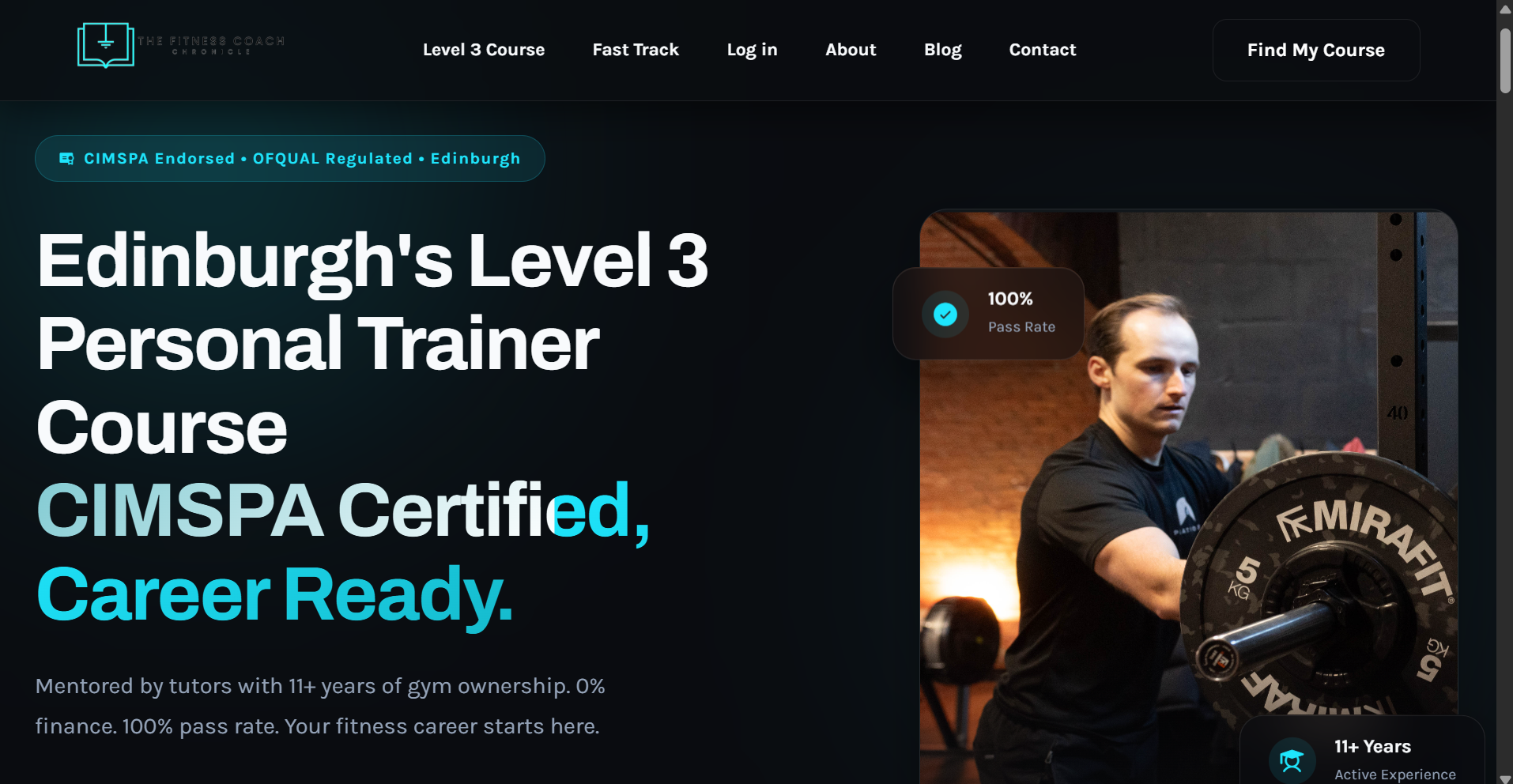
How The Catalyst Method designed, built and SEO-optimised a professional website for Fitness Coach Chronicle — a CIMSPA and OFQUAL accredited Level 3 Personal Trainer course provider in Edinburgh — built from the ground up to capture local search demand and convert visitors into course enquiries.
The Website
Every element of the site was designed with two goals in mind: ranking on Google for local personal trainer course keywords and converting visitors into course enquiries.
What We Delivered
A complete website design, build and SEO implementation. No templates. No compromises. Built to rank and convert from the first day it went live.
Complete website designed and built from scratch, including all pages, layouts, copy structure, brand styling and mobile responsiveness. No off-the-shelf templates — built specifically for the Fitness Coach Chronicle brand and audience.
Every page was optimised with keyword-targeted title tags, meta descriptions, heading structures and internal linking. Google can crawl, understand and rank every key page from day one — a foundation most new sites lack entirely.
Full keyword research mapped to a content and page structure designed to capture local search demand. Each course page targets specific, high-intent local keywords rather than generic terms that are impossible to rank for without a large budget.
CIMSPA and OFQUAL accreditation was positioned prominently across all key pages, including the homepage hero and course pages. Accreditation is a critical trust signal for prospective students — featuring it correctly converts significantly more visitors into enquiries.
Dedicated course pages built and optimised for search terms like "Level 3 Personal Trainer Course Edinburgh". Long-tail, location-specific keywords have far lower competition and far higher buyer intent than broad terms — making them the fastest route to page one rankings for a new site.
The layout was designed to guide visitors towards booking or enquiry actions. Clear CTAs, social proof elements and a clean information hierarchy ensure that visitors who land on the site can easily take the next step without friction.
Full Google Business Profile creation, category optimisation, description copywriting and photo upload. GMB is often the fastest way to capture local search visibility for a new brand — getting it right from the start is critical.
Structured data markup implemented for education provider and course content. This tells Google exactly what courses are offered, where, by whom and what accreditations they carry — enabling rich results in search that improve click-through rates significantly.
The Target Keywords
We mapped the site's structure around the search terms that prospective personal trainer students in Edinburgh were already using.
These location-specific, intent-rich keywords are far less competitive than generic national terms like "personal trainer course UK". A new site targeting local keywords can realistically reach page one in its first three months — something that is impossible when chasing broad terms dominated by large national providers.
Trust Signals That Convert
In the fitness education sector, accreditation is the difference between a lead and a bounce. We built this prominently into every key page.
The Chartered Institute for the Management of Sport and Physical Activity. CIMSPA endorsement is the gold standard for fitness professionals in the UK. Featuring it prominently answers the key trust question prospective students have before they even enquire.
The Office of Qualifications and Examinations Regulation. OFQUAL-recognised qualifications are the official benchmark of regulated, nationally recognised credentials in England. Students researching courses specifically look for this signal before committing.
Google's quality guidelines specifically reference E-E-A-T: Experience, Expertise, Authoritativeness and Trustworthiness. Featuring recognised accreditations and professional bodies signals all four to Google — improving rankings alongside conversion rates.
Structured data was used to encode the course provider's credentials in a format Google can read directly. This creates the possibility of rich results in search — displaying accreditation information in the search results before a user even clicks through.
Professional personal trainer course provider in Edinburgh. CIMSPA and OFQUAL accredited. Offering Level 3 and Level 4 personal trainer qualifications for aspiring fitness professionals across Scotland.
Every Catalyst Method plan includes a free professional website build, CRM setup, lead magnet design and email automation. Get started with a free audit or choose a plan today.
One of the most expensive mistakes local businesses make is launching a website and then — weeks or months later — realising it is not generating any organic traffic. The reason is almost always the same: SEO was an afterthought, not a foundation.
Fitness Coach Chronicle's website was built the right way. Before a single line of code was written, keyword research was completed, the site structure was mapped to search demand, and every page was planned with its target keyword in mind. When the site launched, it was immediately readable by Google — indexed correctly, structured correctly, and pointing signals at the right pages.
This approach — SEO from the first day, not the last — is what gives new sites the fastest possible route to Google rankings.
The fitness industry is competitive online, but most of that competition is at the national level. A personal trainer course provider in Edinburgh is not competing with every fitness provider in the UK — it is competing with other Edinburgh-based providers and a handful of national brands with local landing pages.
That competitive landscape makes location-specific SEO highly effective. By targeting keywords like "Level 3 Personal Trainer Course Edinburgh" and "CIMSPA accredited PT course Scotland", a new site can realistically reach page one within its first few months — without needing a massive backlink profile or domain authority.
The key on-page factors for personal trainer course websites include:
Schema markup is structured data — code added to a website that tells Google, in precise machine-readable language, exactly what the page is about. For a personal trainer course provider, schema markup can specify the course name, the education provider, the accreditation body, the location, the duration and the qualification level.
When Google reads this data correctly, it can display rich results in search — showing course details, ratings or other structured information directly in the search results, before a user even clicks. This dramatically improves click-through rates and can give a new site a visibility advantage over competitors who have not implemented structured data.
The Catalyst Method implements schema markup as standard on every website build, including education, course, local business and FAQ schema as appropriate for each client's industry.
For a business serving a specific local area — like a personal trainer course provider in Edinburgh — Google My Business is often the single highest-impact SEO action available. A fully optimised Google Business Profile increases visibility in the Google Maps pack, in local search results and in branded searches.
Fitness Coach Chronicle's Google Business Profile was set up from scratch and optimised with the correct business category, a keyword-rich description, location data, service listings and professional photos. This gave the business local search visibility from its first week online — a significant advantage over businesses that launch without it.
Yes. The Catalyst Method works with any local service business in the UK that wants a website designed to rank on Google and convert visitors into leads. The free website build is included with every monthly plan starting from £500 per month.
Industries we have worked with include fitness, food and drink, professional services, trades and specialist retailers. If your business serves a local area and you need more enquiries, the system works.
Start with a free 16-point website audit — it takes ten seconds and tells you exactly what Google thinks of your current site, and what needs to change to start ranking.
Read the Creation Coffee case study to see how the same SEO content strategy grew an independent UK coffee brand from 181 to 720 monthly website users in 90 days — with no paid advertising.
Common Questions
What does a professional personal trainer website need to rank on Google?
It needs correct on-site SEO — keyword-optimised title tags, meta descriptions, heading structure and schema markup. Course pages should target local search terms like "Level 3 Personal Trainer Course Edinburgh". Google My Business should be fully set up and optimised. The site also needs to be fast, mobile-friendly and structured to convert visitors into enquiries.
How long does it take to build a website for a fitness business?
The Catalyst Method builds professional, SEO-ready websites as part of every plan. A full design and build — including on-site SEO, copywriting structure, Google My Business setup and schema markup — is typically completed before the monthly retainer begins. The website is included free with every plan from £500 per month.
What keywords should a personal trainer course provider target for SEO?
Location-specific keywords with high buyer intent are the priority — terms like "Level 3 Personal Trainer Course Edinburgh", "personal trainer qualification Scotland" and "CIMSPA accredited PT course UK". These have lower competition than broad national terms and convert at a higher rate because the searcher knows exactly what they want.
Why is schema markup important for a personal trainer course website?
Schema markup tells Google exactly what courses are being offered — including the provider, accreditation, location and level. This can unlock rich results in Google search, displaying course details directly in the search results before a user even clicks, improving click-through rates significantly.
How do I get a website built and SEO-optimised for my fitness or local business?
Start with a free 16-point website audit to see what your current site is missing. Then choose a monthly plan from £500 per month — every plan includes a free professional website build, CRM setup, lead magnet design and email automation. You will be set up to convert from day one.