
Can I do local SEO myself: A Clear Answer for Small Business Owners
Yes, you can handle local SEO yourself, especially for basic tasks, but it requires time, consistency, and some technical knowledge. Here’s what you need to know:
-
Key Tasks You Can Do Yourself:
- Set up and optimise your Google Business Profile (GBP).
- Ensure your business Name, Address, and Phone number (NAP) are consistent across all platforms.
- Collect and respond to customer reviews promptly.
- Create location-specific content to target local keywords.
-
Time Commitment:
- Initial setup: 8–12 hours.
- Weekly maintenance: 4–6 hours.
-
Tools to Help You:
- Free tools like Google Keyword Planner, Google Analytics 4, and Google Search Console.
- Paid tools like Moz Local for managing your business listings efficiently.
-
When to Consider Professional Help:
- If you lack time or technical expertise.
- If your local market is highly competitive.
- If your efforts don’t yield results after 90 days.
Bottom Line: DIY local SEO is feasible for small businesses, but it’s an ongoing effort. If you’re short on time or facing stiff competition, hiring a professional may be a better option.
Core Local SEO Tasks You Can Handle Yourself
How to Set Up and Optimise Your Google Business Profile
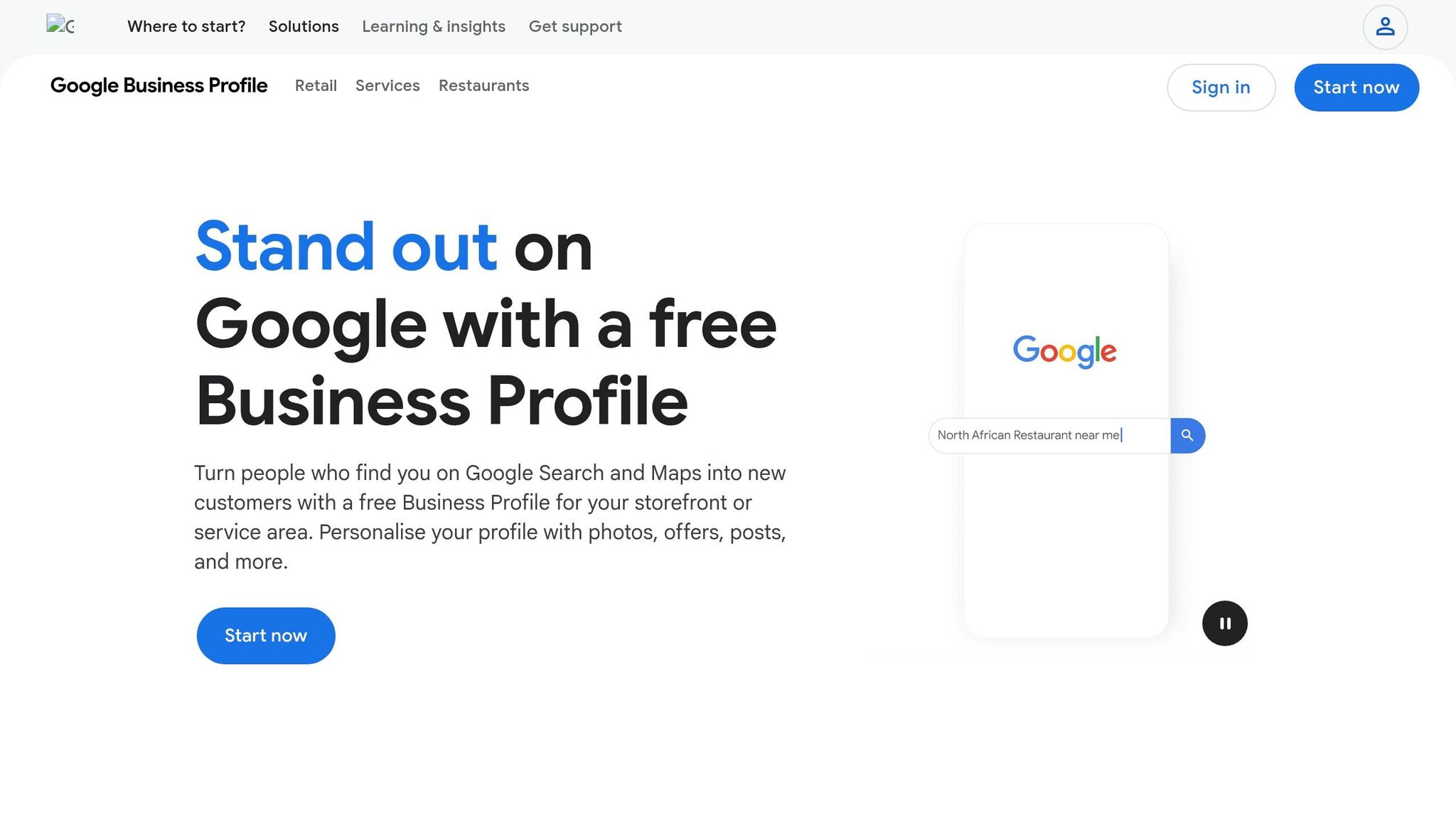
Your Google Business Profile (GBP) is one of the most effective tools for boosting your local SEO. It’s free to use, and when optimised properly, it can dramatically increase your visibility. In fact, businesses with complete and optimised profiles tend to get seven times more clicks than those with incomplete listings.
To get started, visit business.google.com. Search for your business. If it’s already listed, claim it; if not, create a new profile. Verification can be done through a short video showing your exterior, interior, and access points.
When setting up your profile, pick the most specific primary category possible - for example, "Family Law Solicitor" rather than just "Lawyer".
"Your primary category is the single most important setting on your entire Google Business Profile and directly determines which searches your business is eligible to appear for in the Map Pack." - Want SEO
Write a natural, engaging 750-character business description. Focus on your key services and location within the first 250 characters. Add authentic photos of your premises, team, and work to build trust. Keep your profile active by posting updates weekly.
Reviews are another vital part of your GBP. Generate a direct review link from your profile and share it with customers as soon as a job is completed. Respond to all reviews - whether they’re glowing or critical - within 48 hours. This shows Google you’re an engaged and trustworthy business.
The next step? Ensure your business details are consistent across all platforms.
Keeping Your Business Listings Consistent
Your business information isn’t just on your GBP - it’s scattered across various online directories. Any inconsistencies can hurt your rankings. As Darren Shaw, Founder of Whitespark, explains:
"If Google is getting conflicting data about your business from multiple sources, it lowers its trust in your data."
The solution? Create a canonical NAP document - a single reference file with your exact business Name, Address, and Phone number. Use this file to copy and paste your details consistently across all platforms. Pay attention to UK-specific formatting, like including the space in your postcode (e.g., SW1A 1AA) and using a local landline rather than a mobile or 0800 number. This reinforces your local relevance.
Here’s where to focus your efforts:
- Tier 1: Foundational directories (e.g., Google Business Profile, Bing Places, Apple Business Connect): These power Maps, Siri, and AI-driven search results.
- Tier 2: Major UK directories (e.g., Yell.com, Thomson Local, Facebook, FreeIndex): These have high authority and are frequently indexed by Google.
- Tier 3: Industry-specific directories (e.g., Checkatrade, Trustpilot, TripAdvisor, Law Society): These signal credibility in your field.
Bing Places deserves special attention in 2026, as it plays a growing role in ChatGPT’s local business recommendations. Make it a habit to audit your listings quarterly to catch and fix any errors before they impact your rankings.
Once your listings are consistent, shift your focus to using local keywords effectively.
Finding and Using Local Keywords
Accurate business listings work hand-in-hand with your keyword strategy, ensuring your business appears in location-specific searches. Local keywords are search terms people use to find services nearby, like "emergency boiler repair in Stockport" or "wedding florist Bristol." These long-tail phrases often face less competition and lead to higher conversion rates compared to broader terms like "plumber" or "florist".
To identify the right keywords, start with Google Keyword Planner. Enter your main service and location to discover related search terms along with their monthly search volumes. You can also use Google’s autocomplete suggestions and "People also ask" sections to uncover real-world search queries.
Once you’ve gathered your keywords, integrate them naturally into these areas:
- Your GBP business description and Services section
- Your website’s page titles and H1 headings
- Dedicated location pages for different areas you serve (e.g.,
/services/electrician-leeds)
For location pages, make sure each one has unique content, such as local testimonials or area-specific details, instead of just swapping out city names.
One important rule: never add keywords to your GBP business name, like "Smith’s Plumbing – Best Plumber in Manchester." This violates Google’s guidelines and could lead to your profile being suspended.
sbb-itb-6d98f47
Free and Low-Cost Tools for DIY Local SEO
Free Tools for Keyword Research and Tracking
After building your keyword list and organising your business listings, it's important to monitor your progress. Thankfully, there are three free tools that can handle most of your tracking needs.
Google Keyword Planner is a great starting point for identifying local search terms. By setting the location to a specific city or county - like "Manchester" or "Surrey" - you can see search volumes tailored to your area, rather than national averages. Note: you'll need a Google Ads account to access this tool, but running ads isn't required.
Google Search Console gives insight into the search terms already driving traffic to your site and your average ranking. A smart move is to focus on keywords where you rank between positions 11 and 30. These are often "low-hanging fruit" - a few tweaks to your content could boost them onto the first page. Meanwhile, Google Analytics 4 (GA4) provides data on user behaviour, such as pages visited, session lengths, and completed enquiries.
"A keyword with 100 monthly searches and high commercial intent will generate more revenue than a term with 5,000 monthly searches from users with no purchase intent." - Anthony Barone, SEO Specialist, StudioHawk
These tools work together to give you a clear picture of your performance and help you refine your strategy. Once your keyword tracking is underway, it's time to tidy up your business listings with the right tools.
Tools for Managing Your Business Listings
Once your keyword plan is solid, the next step is keeping your business information consistent across the web. This is where tools like Moz Local can make a big difference. This subscription-based tool automates much of the work involved in managing your NAP (Name, Address, Phone Number) data. It scans directories for mentions of your business, flags errors like inconsistent formatting (e.g., "Avenue" vs. "Ave"), and finds duplicate listings that could harm your local SEO.
Moz Local doesn’t just identify problems - it fixes them. It automatically updates major aggregators with accurate information, saving you from manually editing each listing. For small UK businesses balancing multiple tasks, this can be a real time-saver.
| Feature | What It Does for You |
|---|---|
| Citation Audit | Finds all your business listings and checks if the details are accurate |
| Consistency Check | Ensures your NAP details match across major UK directories like Yell and Thomson Local |
| Duplicate Finder | Highlights and removes duplicate entries that might confuse search engines |
| Listing Distribution | Sends updated information to key directories and aggregators automatically |
If you're working with a tight budget, start with the free Google tools and manually fix the most important listings. However, if you find yourself spending more than a couple of hours each month on this task, investing in a tool like Moz Local can save you both time and effort.
Local SEO For Beginners (2026 Complete Guide)
DIY Local SEO or Professional Help: How to Decide
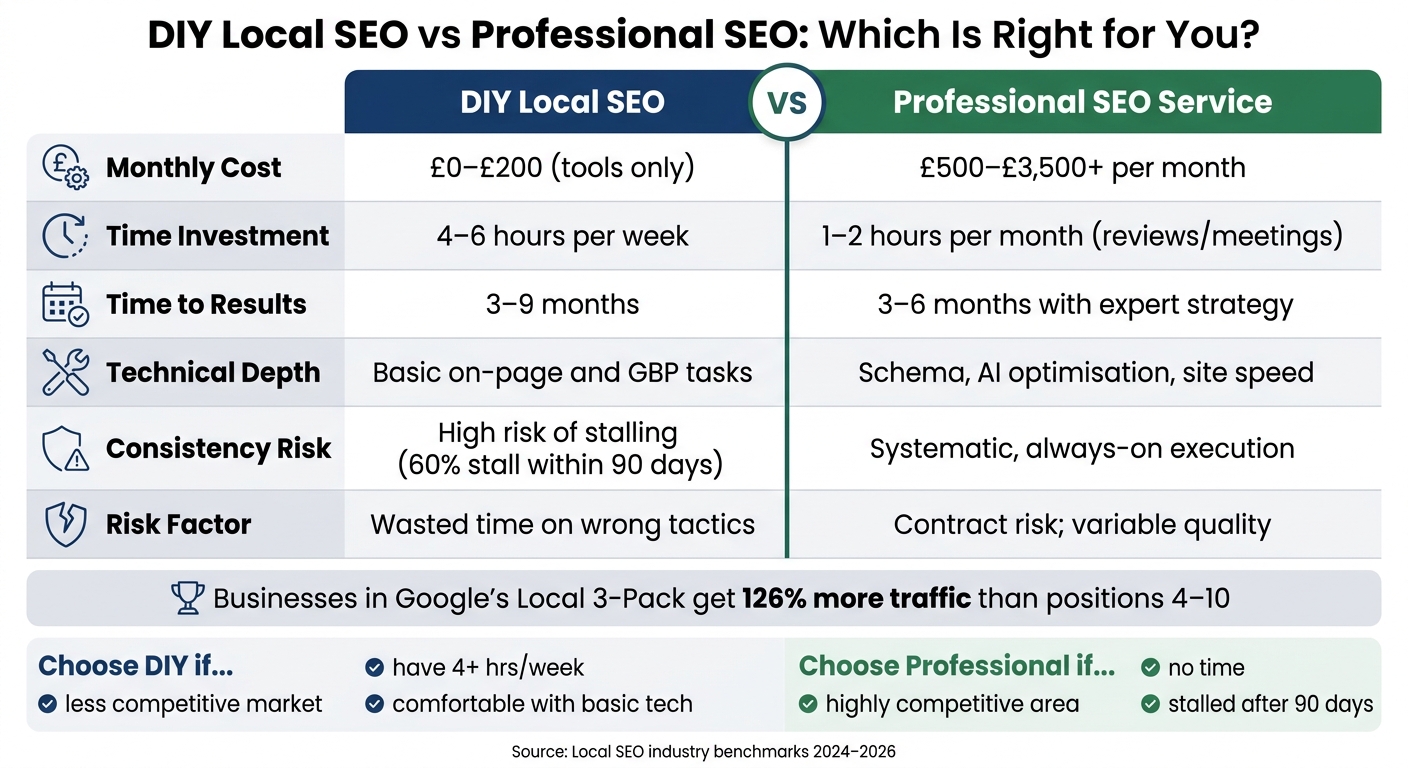
DIY Local SEO vs Professional SEO: Cost, Time & Results Compared
Now that you've got the tools ready, the big question is: should you handle it yourself or bring in the pros? The answer depends on your time, comfort with technology, and the level of competition in your market. Let’s break it down and compare the two approaches.
Checking Your Time, Skills, and Comfort with Tech
Once the initial setup is done, maintaining your local SEO takes about 4–6 hours per week. This isn’t a one-off task - it’s an ongoing commitment.
If you can’t dedicate at least 4 hours weekly for three weeks straight, DIY SEO might not be for you. Studies show that 60% of small businesses attempting DIY SEO stall within the first 90 days. Why? Because many owners treat it as a task to complete rather than a continuous operation.
"The businesses that fail at DIY SEO share one trait: they treat it as a project with a finish line instead of an ongoing operation. SEO isn't a task you complete - it's a function you run." - The SEO Engine
Basic tasks like setting up your Google Business Profile (GBP) and managing reviews don’t require much technical know-how. But more advanced tasks, such as schema markup or fixing crawl errors, come with a steep learning curve - around 20–40 hours of effort. If website management or tools like Search Console feel overwhelming, these challenges could slow you down.
DIY vs Professional Support: A Side-by-Side Comparison
Once your tools and tasks are set up, it’s time to decide if you can manage these activities or if professional help makes more sense.
| Factor | DIY Local SEO | Professional Service |
|---|---|---|
| Monthly Cost | £0–£200 (tools only) | £500–£3,500+ per month |
| Time Investment | 4–6 hours per week | 1–2 hours per month (reviews/meetings) |
| Time to Results | 3–9 months | 3–6 months with expert strategy |
| Technical Depth | Basic on-page and GBP tasks | Schema, AI optimisation, site speed |
| Consistency | High risk of stalling | Systematic, always-on execution |
| Risk | Wasted time on wrong tactics | Contract risk; variable quality |
Here’s an eye-opener: businesses that make it into Google’s local 3-pack get 126% more traffic than those in positions 4–10. The ability to secure - and maintain - that spot often highlights the difference between DIY efforts and professional expertise.
A Step-by-Step Framework to Make Your Decision
Answer these questions to figure out the best option for your business:
- Can you dedicate 4 hours a week? If not, DIY SEO is likely to stall before delivering results.
- Are you comfortable with basic website management? If tasks like managing your website backend or navigating Search Console feel too technical, it could hinder progress.
- How competitive is your local market? In less competitive areas, regular GBP updates and accurate citations might be enough. But in high-competition zones - like central London or Manchester - you’ll need more advanced strategies.
- Has your progress plateaued? If you’ve been consistent for three months but haven’t seen an increase in calls or enquiries, it might be time to seek professional help.
A middle-ground option is a hybrid model: manage your GBP updates and review responses yourself (these account for about 70% of local SEO results) while outsourcing technical tasks like audits or link-building to experts. For example, services like The Catalyst Method offer fully managed SEO, content creation, and lead generation tools starting at £500 per month - ideal for those wanting results without the weekly time drain.
"If you've done the self-directed review, fixed the obvious issues, and you're still not seeing movement in calls or enquiries after three months, it's time to bring in professional support." - Jonathan Bird, Founder, Delivered Social
This decision isn’t just about your budget or pride - it’s about being honest with yourself about what you can consistently manage week after week.
How to Keep Your Local SEO Results Over Time
Setting up your local SEO is just the beginning. The real challenge lies in maintaining those results. Once you've built a solid foundation, consistent monthly actions are key to keeping your rankings strong. Businesses with lasting success in local SEO aren't doing anything flashy - they're simply consistent. Small, regular efforts add up over time, strengthening the groundwork you've already laid.
Monthly Tasks to Stay on Top of Local SEO
One of the most important habits is responding to reviews within 24–48 hours. Google considers factors like the number of reviews, how recent they are, and your response rate when ranking businesses. As SEO specialist Liam Hayward points out:
"A thoughtful response to a 1-star review often matters more to future customers than the review itself." - Liam Hayward, SEO Specialist
Besides reviews, posting weekly Google Posts is a great way to stay visible. Whether it’s an offer, a news update, or a seasonal promotion, these posts keep your profile active. Remember, most Google Posts expire after seven days, so consistency is key. Businesses that post weekly tend to see 520% more actions compared to inactive profiles.
Another key task is uploading 2–4 new, geo-tagged photos each month. These could be of your premises, team, or recent projects. Also, check your GBP (Google Business Profile) Insights for the "Searches used to find your business" report. This data can help you discover new keywords to target.
| Task Frequency | Action | Why It Matters |
|---|---|---|
| Weekly | Publish a Google Post | Shows Google that your profile is actively managed |
| Weekly | Respond to new reviews | Builds trust and strengthens local visibility |
| Monthly | Upload 2–4 fresh photos | Boosts engagement and increases requests for directions |
| Monthly | Review GBP Insights data | Highlights valuable keywords and search trends |
| Quarterly | Conduct a full citation and NAP audit | Ensures your business details remain accurate across directories |
Every quarter, take time to perform a thorough citation and NAP (Name, Address, Phone number) audit on platforms like Yell, Thomson Local, and Bing Places. This helps catch any errors or outdated information caused by "citation drift". Also, keep an eye on your top three competitors. Look at their categories, review counts, and how often they post updates.
If you're putting in consistent effort but not seeing results - like no increase in enquiries - it might be time to rethink your strategy.
Signs It's Time to Get Professional Help
Sometimes, even with regular upkeep, your local SEO efforts may plateau. If after 90 days of maintaining your GBP, responding to reviews, and auditing citations, you’re still not getting more calls or enquiries, it’s worth seeking professional assistance.
Other red flags include a suspension of your Google Business Profile (which is a compliance issue), recurring schema or Core Web Vitals errors that you can’t fix, or plans to expand into new locations or service areas. If your business operates in a competitive market - like central Birmingham or Manchester city centre - you might also need advanced technical expertise that goes beyond what you can manage on your own. Hiring a professional isn’t a sign of failure; it’s a smart way to make better use of your time and resources.
Conclusion: Choosing the Right Path for Your Business
The straightforward answer to "can I do local SEO myself?" is: yes – but only for the basics. Tasks like claiming your Google Business Profile, ensuring consistent NAP (Name, Address, Phone) details, collecting authentic reviews, and sharing regular updates can all be handled without professional assistance. These foundational efforts are often enough to make a noticeable impact, especially for small businesses in less competitive areas.
However, as your business grows or if you're operating in a highly competitive market, the challenges of managing local SEO effectively can become overwhelming. Factors like time constraints, the complexity of SEO strategies, and the need to stay ahead of competitors can quickly escalate. It's worth noting that 52% of small business owners who initially managed SEO themselves eventually chose to hire external help. Of these, 71% said the main reason was simply not having enough time.
If you're feeling stuck or unsure about the next steps, The Catalyst Method provides a helpful solution. Their free 60-second audit can quickly identify where your business might be losing visibility online. For those who need more hands-on support, their local SEO service, starting at £500 per month, is tailored specifically for busy UK small businesses. It’s a way to maintain strong rankings without having to sacrifice your valuable time to SEO tasks.
FAQs
What’s the fastest local SEO win I can do this week?
If you want to see a noticeable boost in your local SEO this week, the best place to start is by fully optimising your Google Business Profile. Here’s how you can make an impact quickly:
- Choose a specific primary business category: Make sure your primary category accurately reflects what your business is all about. This helps Google understand your services and match you with relevant local searches.
- Upload recent, high-quality photos: Fresh images not only make your profile more appealing to potential customers but also signal to Google that your profile is active and up-to-date.
- Set up a process for collecting customer reviews: Positive reviews build trust and show Google you're a credible business. Create a simple system to encourage happy customers to leave feedback consistently.
These steps can strengthen how relevant and trustworthy your business appears to Google, often delivering quicker results than many other marketing strategies.
How do I fix duplicate or incorrect business listings online?
To address duplicate or incorrect listings, make sure your business name, address, and phone number (NAP) are consistent across all directories. An easy way to spot issues is by searching your NAP in quotes online to identify errors or duplicate entries. Once found, claim any duplicate profiles so you can remove them or update incorrect details. Tools like BrightLocal, Whitespark, or Moz Local can simplify this process by scanning directories for inconsistencies and helping you fix them more efficiently.
How can I tell if my local SEO is working without paid tools?
Keeping tabs on your local SEO performance doesn’t have to cost a penny. Here are a few ways to monitor your progress effectively:
- Google Business Profile Dashboard: Dive into engagement metrics like calls, clicks, and direction requests. If these numbers are climbing, it’s a clear sign your visibility is improving.
- Google Search Console: This tool helps you track impressions and clicks from local searches. It’s a great way to see how often your business appears in search results and how many people are clicking through.
- Customer Reviews and Website Conversions: Pay attention to reviews and actions like completed forms or bookings on your website. These indicators show whether your SEO efforts are actually driving business growth.
By using these tools, you can get a clear picture of how your local SEO strategies are performing.