How do I do local SEO for my business: A Clear Answer for Small Business Owners
Local SEO helps your business appear in Google searches when nearby customers are looking for services you provide. Whether you're a plumber, accountant, or shop owner, local SEO ensures you're visible when it matters most. Here's how to get started:
- Set up your Google Business Profile (GBP): Claim and verify it, then fill in all details accurately, including your name, address, and phone number (NAP). Add photos, services, and regular updates.
- Consistency matters: Ensure your NAP is identical across your website and directories like Yell or Thomson Local. Even small differences can hurt rankings.
- Encourage reviews: Ask satisfied customers to leave reviews on Google. Respond to all reviews, both positive and negative, promptly.
- Optimise your website: Include location-specific keywords (e.g., "plumber in Bristol") in titles, headings, and content. Use a clear layout and ensure your site is mobile-friendly.
- Focus on local backlinks: Build links from local organisations, news outlets, or directories to boost your authority.
- Track results: Use tools like Google Business Profile Insights and Google Search Console to monitor traffic, calls, and customer actions.
Why it matters: Nearly half of Google searches have local intent, and most people contact a business within 24 hours of searching. Local SEO connects you with ready-to-buy customers.
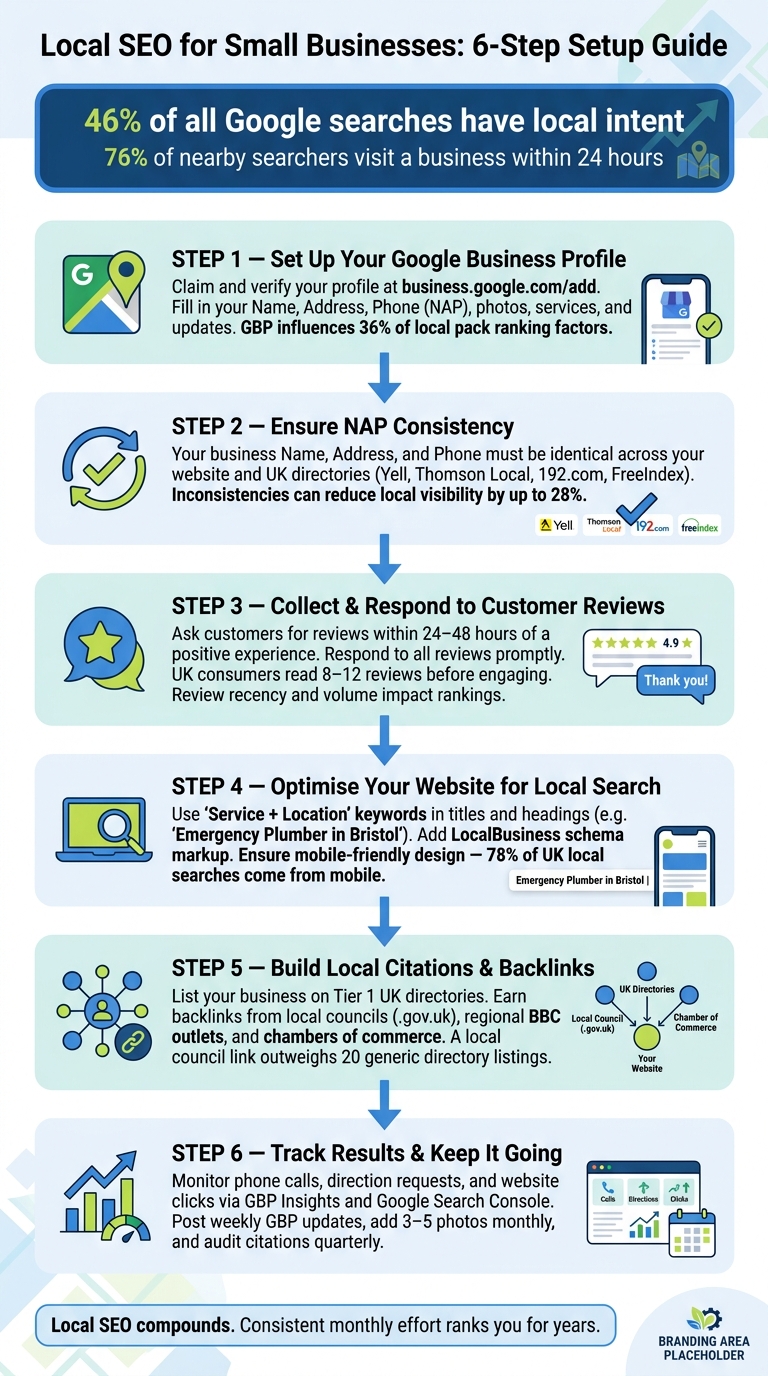
Local SEO for Small Businesses: 6-Step Setup Guide
Local SEO For Beginners (2025 Complete Guide)
The Basics of Local SEO
Local SEO relies on four main components: your Google Business Profile (GBP), UK-specific citations, customer reviews, and website optimisation. If one of these areas falls short, the others will need to work harder to make up for it.
Key Elements of Local SEO
Google evaluates local businesses using three primary factors: relevance, distance, and prominence. Here's what each means:
- Relevance: Does your business align with the searcher's query? This includes your GBP categories, business description, and listed services.
- Distance: How close is your business to the searcher or the area they’re looking in?
- Prominence: How well-known and trusted is your business? This is influenced by review volume and ratings, citations, and local backlinks. Consistency in your NAP (Name, Address, Phone) across UK directories like Yell, ThomsonLocal, and FreeIndex is crucial. Even small inconsistencies, such as "St." versus "Street", can reduce your visibility in local searches by up to 28%.
| Ranking Factor | Details |
|---|---|
| Relevance | GBP categories, business description, services listed |
| Distance | Proximity to searcher or defined service area |
| Prominence | Reviews, citations, local backlinks, consistent NAP data |
Your GBP is the most impactful tool in your local SEO arsenal. As one expert puts it:
"Your primary category is the single most important ranking factor for local search visibility." - Respect Experts
Additionally, your website should send local signals. Use LocalBusiness schema markup, include your NAP in the footer, and build backlinks from trusted local sources like newspapers, councils, and business groups.
Lastly, define your service area to ensure your local signals reflect the actual locations you serve.
How to Define Your Local Service Area
Not every business operates from a physical location. For businesses like mobile hairdressers or plumbers, Google categorises you as a Service Area Business (SAB). In this case, defining your service area on GBP helps Google determine which "near me" searches you should appear in.
Precision is key. Google allows up to 20 service areas, and it’s better to focus on specific cities, towns, or postcodes rather than claiming a broad radius. For example, if you primarily serve West Yorkshire, listing the specific towns or cities within that area is far more effective than setting a large, vague region.
"Service areas are set by city, postcode, or other areas, not as a radius. You can add up to 20 service areas." - Kered Pople, SEO Specialist, KAP SEO Services
If you work from home and prefer not to display your address publicly, you can hide it on GBP while still ranking locally. For better results, create unique, location-specific pages on your website for each main town or borough you serve.
By accurately defining your service area, you can better align your efforts and measure the impact on your business.
How to Track Results That Matter
While many business owners focus on keyword rankings, the metrics that truly matter are more straightforward: phone calls, direction requests, website clicks, and form submissions. All of these are available in your GBP performance dashboard.
Before making any changes, record your baseline metrics, including photo count, primary category, and recent 28-day performance data. Keep a simple log of changes, noting what you updated and when. For instance, if you add ten new photos and see an increase in direction requests the following month, you’ll know the update worked.
Google Search Console is another essential tool. It shows which local queries - like "accountant in Bristol" or "near me" searches - are driving traffic to your site and where competitors might be outperforming you. Together, GBP and Search Console provide a solid foundation for tracking your local SEO success without spending a penny.
How to Set Up and Optimise Your Google Business Profile
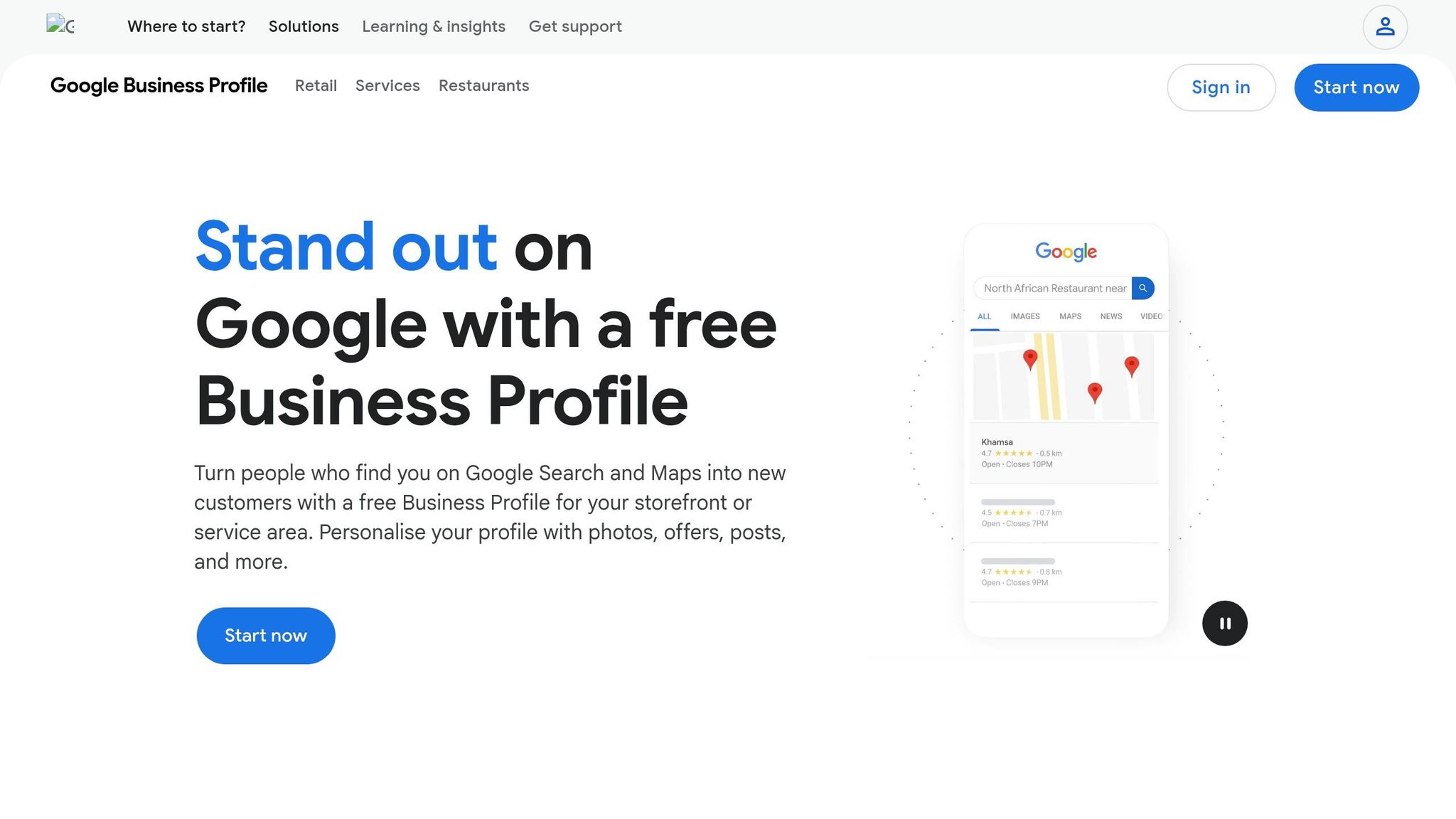
Your Google Business Profile (GBP) is a free tool that packs a punch, influencing 36% of local pack ranking factors. For small businesses aiming to attract local customers, it’s a must-have.
How to Create and Verify Your Profile
Start by visiting business.google.com/add to create your profile. If your business already appears on Google Maps but hasn’t been claimed, simply select "Claim this business." Keep in mind that verification is essential - without it, your profile won’t have the visibility or ranking power it needs.
Google offers several verification methods depending on your business type. You might receive a postcard (typically within 5–14 days), or you could verify via SMS, email, or even a short video call showing your shopfront, interior, and signage. Once you’ve completed the process, Google usually reviews your submission within five working days.
When selecting your primary category, choose one that’s highly specific. For instance, "Family Law Solicitor" is far more effective than a generic "Lawyer." This choice impacts around 32% of your ranking weight. Stick to your official business name - adding keywords like "Best Emergency Plumber London" can violate Google’s guidelines and might even result in suspension.
After verification, focus on completing your profile to improve both visibility and customer trust.
How to Fill In and Maintain Your Profile Details
A well-filled profile not only boosts your rankings but also builds credibility. Businesses with accurate, detailed profiles are twice as likely to be seen as trustworthy and can attract up to seven times more clicks compared to incomplete profiles.
Use the 750-character limit in your business description wisely - prioritise key information in the first 250 characters, as the rest may be truncated. Populate the services and products sections with clear descriptions and pricing. Add relevant attributes like "Wheelchair accessible" or "Free Wi-Fi" to align with specific search queries.
Photos play a critical role too. Businesses with 100+ images receive 42% more direction requests and 35% more website clicks than those with fewer than 10 photos. Aim to upload at least one new photo weekly, mixing exterior shots, interior images, and team photos. Regularly posting updates via Google Posts (which expire after seven days) also signals to users that your business is active.
"A half-finished or neglected profile sends a signal that your business might not be active or trustworthy." - John Mitchell, Forest Software
How to Manage Customer Reviews on Google
Customer reviews are a game-changer for local rankings and converting potential customers. Google evaluates review volume, recency, star ratings, and how promptly businesses respond. On average, UK consumers read 8–12 recent reviews before deciding to engage.
To gather reviews, ask customers for feedback right after a positive experience - this is when they’re most likely to respond. Use the direct review link in your GBP dashboard and share it via follow-up emails or SMS to make the process simple.
Respond to reviews within 24–48 hours. When replying to positive feedback, naturally include references to the service provided, such as, "We’re thrilled to have helped with your boiler installation in Sheffield." For negative reviews, acknowledge the issue, apologise, and offer to resolve it privately. This approach not only helps the reviewer but also reassures potential customers who read your responses.
"A thoughtful response to a 1-star review often matters more to future customers than the review itself." - Liam Hayward, SEO Specialist
How to Make Your Website Work for Local Search
Your website plays a key role in turning online visitors into local customers. While your Google Business Profile can help you show up in the local pack, it’s your website that convinces searchers to take action. When these two elements work together, your local SEO strategy becomes much more effective.
On-Page Optimisation for Local SEO
Start with NAP consistency - your business Name, Address, and Phone number should be exactly the same across your website’s footer and contact page. Even small inconsistencies, like writing "St." on one page and "Street" on another, can hurt your rankings.
For page titles, use this straightforward formula: Service + Location + Value Proposition. For example: "Emergency Plumbing in Stockport: 24-Hour Same-Day Service" works far better than a generic title. Also, weave your primary location naturally into your H1 heading, early paragraphs, and image alt text.
If you serve multiple locations, create a separate landing page for each area. Google's November 2025 core update penalised sites with thin, repetitive location pages. To avoid this, make each page unique by including 500–800 words of original content, local testimonials, and details specific to the area you’re targeting.
"The single most reliable predictor of whether a local landing page ranks: it has unique, locally-relevant content that wouldn't apply identically to any other location." - Liam Hayward, SEO Specialist
Once your content is in place, focus on the technical side to ensure your website performs well for local users.
Mobile Usability and Technical Basics
Technical performance is just as crucial as content, especially since 78% of local searches in the UK come from mobile devices. A slow-loading site can drive potential customers away, so aim for a Google PageSpeed Insights mobile score of 70 or higher, and ensure your Largest Contentful Paint (LCP) stays under 2.5 seconds.
Make it easy for users to contact you by enabling click-to-call functionality on phone numbers. Embedding a live Google Map on your contact page can also help customers locate you easily. To boost your visibility further, implement LocalBusiness schema using JSON-LD structured data. For UK businesses, include addressCountry: "GB" and format phone numbers with +44.
Keyword Research for Local Businesses
Once your on-page and technical elements are optimised, refine your strategy with the right keywords. Focus on "service + location" phrases like "emergency plumber in Bristol" or "family law solicitor in Leeds." These targeted, high-intent keywords are easier to rank for and attract customers who are ready to take action.
With 58% of consumers using voice search to find local businesses, it’s also worth targeting conversational phrases. Think about how someone might ask, "Where can I find a plumber who can come out tonight?" Adding an FAQ section to your location pages can help you appear in voice search results and Google's AI Overviews, which now feature in roughly 68% of local-intent searches.
"A page called 'Welcome to our website' does not work. Google cannot do much with vague. Neither can your future customer." - Martin Reynolds, Web Designer & SEO Specialist
sbb-itb-6d98f47
How to Build Local Authority Through Citations, Reviews, and Backlinks
To enhance your business's local presence, it's essential to establish authority through consistent citations, positive customer reviews, and meaningful backlinks. Once your site is technically optimised and your content is in good shape, these steps can help solidify your position as a trusted local business in Google's eyes.
How to Create and Manage Online Citations
Citations are mentions of your business's Name, Address, and Phone Number (NAP) on external platforms like directories, trade sites, or social networks. Google relies on these mentions to confirm the legitimacy of your business and verify your Google Business Profile. The key here is consistency - your NAP details must be identical across all platforms. Even small inconsistencies can reduce your local visibility by up to 28%.
"NAP consistency means your business name, address, and phone number are identical across every citation. Not similar. Identical." - John Carey, SEO Consultant
Start by auditing your existing citations using tools like BrightLocal or Moz Local to spot errors or duplicates. Correcting these issues lays the groundwork for building new, accurate listings. When adding citations, focus on Tier 1 UK directories such as Yell, Thomson Local, 192.com, FreeIndex, and Scoot. These are not only highly authoritative but also feed data to smaller directories. Don’t forget to claim your business on Bing Places for Business and Apple Business Connect to cover platforms outside of Google Maps.
Most core UK directories offer free basic listings, making this an affordable yet impactful strategy. Here’s a quick breakdown of citation tiers and their importance:
| Citation Tier | Platform Examples | Why It Matters |
|---|---|---|
| Tier 1: Core UK | Yell, Thomson Local, 192.com, FreeIndex, Scoot | Highest authority; feeds smaller directories |
| Tier 2: General | Yelp UK, Hotfrog, Cylex, Facebook | Adds additional prominence data points |
| Tier 3: Industry | Checkatrade, TrustATrader, Law Society, NHS Choices | Sector-specific relevance and trust |
| Tier 4: Local | Local councils, Chambers of Commerce, BIDs | Strongest geographic relevance signals |
For service-area businesses that hide their address on their Google Business Profile, ensure the same approach is applied across your website and directory listings. This avoids potential inconsistencies that might harm your credibility.
Once your citations are aligned, shift focus to gathering customer reviews - a key factor in building trust and improving local rankings.
How to Collect Reviews Across Multiple Platforms
Customer reviews play a significant role in local SEO. Google assesses the volume, star ratings, and recency of reviews, so consistently collecting fresh feedback is crucial.
Encourage reviews via email or SMS within 24–48 hours of a transaction. Use short links or QR codes to make the process simple, and ask customers to mention specific services or locations in their feedback. This naturally integrates relevant keywords into their reviews. While Google is the primary platform for reviews, don’t overlook others like Trustpilot, Checkatrade, and Rated People, which can further enhance your business's online reputation.
Always respond to reviews - both positive and negative - to show that you value customer feedback. Quick responses also align with Google’s and the UK ASA's guidelines, reinforcing trust with potential customers.
While reviews build credibility, backlinks can elevate your local authority even further.
How to Earn Local Backlinks
Backlinks from trusted, locally relevant sources are a powerful way to boost your local rankings. For UK businesses, links from .gov.uk council websites, regional BBC news outlets, and .ac.uk university pages carry significant weight, signalling both authority and geographic relevance.
"A link from a local council website or a regional BBC news article is worth more than 20 general directory listings for Local Pack prominence." - Kered Pople, KAP SEO Services
To earn these high-value backlinks, consider sponsoring local events, joining chambers of commerce, or providing expert insights to journalists. Memberships in organisations like the Federation of Master Builders often include directory listings with backlinks, though annual fees typically range from £100 to £500. Tools like ResponseSource or JournoRequests can help you connect with journalists for editorial opportunities.
Another effective approach is creating content tailored to your local audience. For example, publish a guide on business grants available in your city or a detailed overview of local planning regulations. This type of content not only attracts backlinks but also engages local customers, reinforcing your SEO efforts and driving long-term growth.
How to Measure Results and Keep Your Local SEO Going
Once you've established your local authority, it's essential to track your progress to maintain and grow your presence effectively.
Key Metrics to Track for Local SEO
After setting up citations, gathering reviews, and building backlinks, it's time to evaluate whether your efforts are yielding results. The most critical metrics fall under four categories: visibility, engagement, reputation, and conversions.
| Metric Category | What to Measure | Why It Matters |
|---|---|---|
| Visibility | Local 3-Pack rank for target keywords | Around 75% of local clicks go to the top 3 map results |
| Engagement | Direction requests and website clicks from GBP | These actions often indicate strong purchase intent |
| Reputation | Review velocity (new reviews per month) | Google favours consistent activity over a static review total |
| Conversion | Phone calls and form submissions from local search | Directly reflects the leads your local presence generates |
Within Google Business Profile (GBP) Insights, pay attention to discovery searches. These searches show how often users find your business through category or service-related queries. A growing share of these searches indicates improving local visibility.
"Review momentum matters more than raw numbers. A business with 200 reviews that consistently gets 20 new reviews every month can often outperform a business with 500 reviews that hasn't had meaningful activity in ages." - Will Tombs, Founder, Buried
To stay ahead, make use of tools that allow real-time monitoring of these metrics.
Tools to Track and Improve Your Local SEO
Two free tools are indispensable for local SEO: Google Search Console (GSC) and Google Analytics 4 (GA4). GSC provides insights into which local queries - like "plumber in Bristol" or "accountant near me" - are driving traffic and which pages are appearing in search results. GA4, on the other hand, tracks what visitors do once they land on your site.
For more precise tracking, use UTM parameters in GA4. By adding ?utm_source=google&utm_medium=gbp to your website URL in your GBP settings, you can differentiate traffic from your Google Business Profile from general organic traffic. This helps you measure how many leads your local SEO efforts are generating.
To monitor your local map pack rankings across your service area, tools like Local Falcon or Whitespark are incredibly helpful. These geo-grid tools visually show where you rank in different locations within your town or city.
With these insights, you can refine and sustain your local SEO efforts.
How to Keep Your Local SEO Strategy Running
Maintaining local SEO requires consistent effort.
"Local SEO in 2026 is a maintenance game, not a setup game. The businesses that hold map-pack positions are the ones feeding GBP new signals weekly." - Inzimam Ul Haq, Founder, Codivox
The good news? Staying active doesn't have to consume your entire week. Here are some manageable tasks to keep your strategy on track:
- Post weekly updates on your GBP.
- Add three to five new photos every month.
- Respond to reviews within 24–48 hours.
On a quarterly basis, audit your citations to catch any NAP (Name, Address, Phone) inconsistencies that might arise from data updates by aggregators. Also, update your GBP attributes and services list to stay relevant for AI-powered search results. These small but consistent actions reinforce the groundwork you've already laid, strengthening your citations, reviews, and on-page signals over time.
"Local SEO is the highest-ROI channel for service businesses. The secret isn't any single tactic. It's doing all of them consistently, month after month." - Hardik Shah, Founder, ScaleGrowth.Digital
Another practical tip is to actively manage the Q&A section of your GBP. Post and answer frequently asked questions yourself. With Google's Gemini AI increasingly relying on structured data from GBP for local search summaries, providing accurate answers can help prevent potential misinformation about your business.
Conclusion: Next Steps for UK Small Business Owners
Local SEO is an effective way for small businesses to reach nearby customers. With 46% of all Google searches having local intent and 76% of people searching for something nearby visiting a business within 24 hours, the opportunity is clear. These numbers highlight the importance of connecting with local audiences.
The practical steps outlined earlier are just the beginning. By maintaining a well-optimised Google Business Profile, ensuring consistent NAP (Name, Address, Phone) details across trusted UK directories like Yell, Thomson Local, and 192.com, and encouraging a steady stream of customer reviews, you can build credibility and trust. Add to that a technically sound, mobile-friendly website, and you’ll be in a strong position to turn online visibility into real-world enquiries. When approached consistently, these efforts create a local search presence that drives action.
"Local SEO compounds. The work you do this month ranks you for years. It's the best long-term investment a small business can make in its marketing." - Ranjan Barman, Blogrator
It’s important to remember that local SEO isn’t a one-and-done task. Regular updates, review responses, and citation management are essential to keep your strategy effective. While these ongoing efforts may seem daunting, a structured approach can make all the difference.
For small businesses looking to simplify this process, the Catalyst Method offers a tailored solution. For £500 per month, this service handles everything from keyword optimisation to content creation and even provides a lead generation dashboard - allowing you to focus on your customers while your online presence works behind the scenes.
FAQs
How long does local SEO take to work?
Local SEO typically starts to show progress within 3 to 6 months, but building a strong local presence can take anywhere from 6 to 12 months. In the first 30 to 90 days, you might notice small wins, like improved visibility on your Google Business Profile or slight shifts in keyword rankings.
The timeline for results depends on several factors, including the level of competition in your industry, the current state of your website, and how consistently you work on your SEO efforts. It's a gradual process that revolves around earning trust - not just with Google but also with your local audience.
Should I hide my home address on Google Business Profile?
If your business involves travelling to customers - like a consultant or a mobile tradesperson - it’s best to hide your home address and instead specify your service area using postcodes. However, if customers come to your physical location, you’ll need to display your address to meet Google’s guidelines.
What should I do if my business has duplicate directory listings?
Duplicate listings can damage your online visibility and create confusion for potential customers. Begin by reviewing your business name, address, and phone number across Google Maps and major directories. Identify the most accurate and verified listing to serve as your primary one. If you manage duplicate listings, either merge or delete them directly through your account. For listings outside your control, use the 'suggest an edit' option to report them. Make sure your business details are consistent across all platforms.