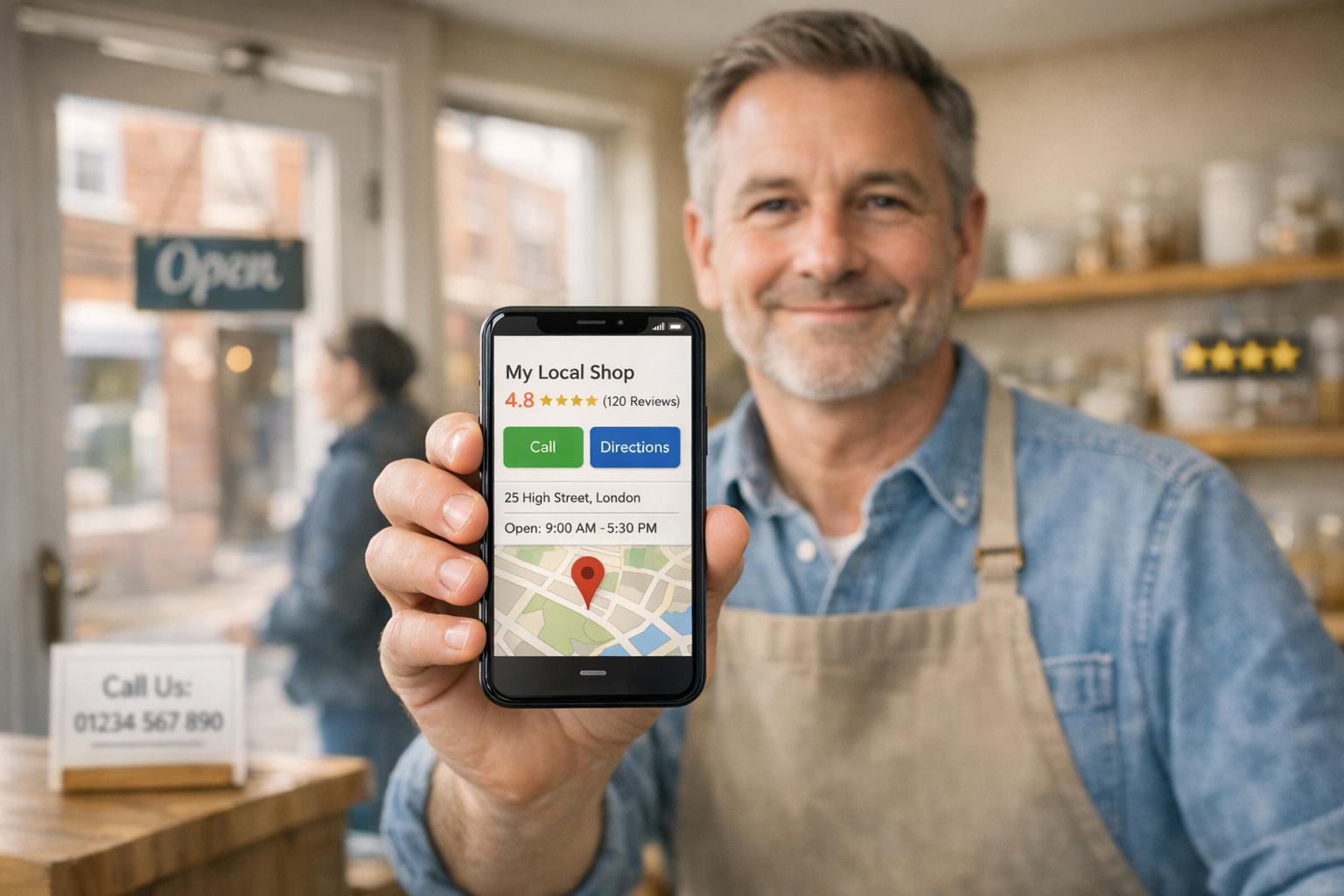
What is a local SEO example: A Clear Answer for Small Business Owners
Local SEO helps your business appear in search results when people nearby look for services you offer. For example, if someone searches for “emergency plumber in Manchester” or “hair salon near me”, local SEO determines which businesses show up. Why does it matter?
- 76% of local searches on smartphones lead to a visit within a day.
- 78% of these searches result in an offline purchase.
- 46% of all Google searches are for local information.
For small businesses in the UK, like a café in Bristol or a dental practice in Edinburgh, local SEO can drive calls, bookings, and foot traffic. The key is to optimise your Google Business Profile (GBP), ensure consistent business details (NAP), and create location-specific website content.
Want to succeed? Focus on:
- Completing your GBP with accurate, detailed information.
- Collecting and responding to customer reviews regularly.
- Adding unique content tailored to the areas you serve.
Local SEO isn’t a one-time task - it’s about consistency. Get it right, and you’ll attract more local customers without needing to spend on ads.
Boost Your Small Business: Mastering Local SEO
sbb-itb-6d98f47
Local SEO Basics Every UK Business Owner Should Know
Before diving into practical local SEO tactics, it’s essential to grasp the basics. Your business can appear in three main areas on Google: the Local Pack, local organic results, and Google Maps. While each functions differently, they all depend on the same foundational signals.
The Local Pack - also known as the 3-Pack or Map Pack - is that prominent block of three business listings pinned to a map at the top of Google search results. It’s the most visible area, especially on mobile devices, where 84% of local searches take place. Being listed here can make a massive difference, as businesses in the Local Pack receive 126% more traffic than those ranked between positions 4 and 10. Below this section are the local organic results, which are the standard blue links. These rely more heavily on your website’s content, backlinks, and technical setup rather than just your Google Business Profile.
Key Local SEO Terms Explained
Getting familiar with a few key terms helps simplify local SEO.
Your Google Business Profile (GBP) is a free listing that determines how your business appears on Google Search and Google Maps. Think of it as a mini-website within Google - it’s where potential customers can find your address, opening hours, photos, and reviews before they even visit your main website. GBP signals are critical, accounting for around 32–36% of the factors influencing Local Pack rankings. This makes it the most important element for securing one of those coveted top three spots.
NAP consistency refers to ensuring your business Name, Address, and Phone number are identical across all platforms - your website, GBP, and major UK directories like Yell or ThomsonLocal. Even minor inconsistencies, such as using "Road" in one place and "Rd" in another, can confuse Google and hurt your visibility.
"Consistent NAP is important to your 'trust score' in local. If Google is getting conflicting data about your business from multiple sources, it lowers its trust in your data." - Darren Shaw, Founder, Whitespark
Citations are mentions of your business details on third-party websites. In the UK, the most valuable citation sources include Yell, ThomsonLocal, FreeIndex, Scoot, and 192.com. Businesses with consistent NAP data across major citation sites are 40% more likely to appear in the Local Pack.
Local SEO Considerations Specific to UK Businesses
For UK businesses, a few specific details can impact how Google interprets and ranks your profile.
Address formatting is crucial. Stick to the standard UK format, which includes the house number, street name, town or city, county, and postcode (e.g., 14 Deansgate, Manchester, M3 4LY). Ensure this format is used consistently across all platforms. In densely populated cities like London or Manchester, rankings can differ significantly between postcodes that are just a mile apart.
Using a local dialling code (e.g., 0161 for Manchester) instead of a national 0800 number can also boost your geographic relevance. If you’re a mobile tradesperson - such as a plumber or electrician working from home - you can hide your home address in your GBP and instead set your service area by boroughs or postcodes.
One often-overlooked detail is UK bank holidays. Be sure to manually update your "Special Hours" in GBP for days like Boxing Day or the August bank holiday. Incorrect or outdated hours are a common source of negative reviews, and keeping them accurate shows Google that your profile is actively managed.
These foundational steps are essential for building a strong local SEO strategy tailored to small businesses in the UK.
Local SEO Examples for Small Businesses
Local SEO can make a massive difference for small businesses trying to stand out in their communities. Whether you're running a hair salon in Leeds, working as an electrician in Bristol, or managing a dental practice in Edinburgh, applying these strategies can help you climb the ranks in local search results. The difference between being visible in Google's Local Pack and getting buried in the results often comes down to a few key actions.
How to Build a Complete Google Business Profile
Your Google Business Profile (GBP) is one of the most critical tools in your local SEO arsenal. In fact, GBP signals contribute to around 36% of local pack ranking factors. If your profile is incomplete, you're missing out on a big opportunity.
Start by filling out all 30+ fields in your profile. This includes detailed service descriptions, selecting the most relevant primary category, and adding specific attributes. For example, a dental practice should choose "Dental Clinic" rather than something vague like "Health Services", while an electrician should opt for "Electrician" instead of "Tradesperson."
Photos are another game-changer. Businesses that upload 30 or more real photos see 35% more website clicks. Use authentic images of your team, workspace, and completed projects. For instance, a Manchester-based salon could upload pictures of its interior, styled haircuts, and staff members. Be sure to name your image files descriptively (e.g., "manchester-hair-salon-interior.jpg") to help with indexing.
Keeping your profile active also sends positive signals to Google. Posting updates weekly - whether it’s a seasonal promotion, a new service, or a completed project - keeps your profile fresh. You can also pre-fill the Q&A section with common customer questions, like "Do you offer emergency callouts in South London?" This lets potential customers find answers quickly and decide if your business fits their needs.
Finally, make sure your website content aligns with your GBP for maximum impact.
How to Add Local Content to Your Website
Your website should back up the location signals in your GBP. One effective way to do this is by creating Service × Area pages. These are individual pages targeting specific locations with 500–800 words of unique content. For example, an electrician in North London could create separate pages for Camden, Islington, and Hackney, each discussing local property types, common services in the area, and showcasing customer testimonials.
Ensure your website footer includes your full and consistent NAP (Name, Address, Phone) details with local dialling codes. On your contact page, you could also add directions featuring nearby landmarks to help users. Adding LocalBusiness JSON-LD schema to your site is another smart move. This structured data tells Google your exact location and services in a machine-readable format. For UK businesses, set the addressCountry to "GB" and use phone numbers in the +44 format.
"The businesses that win at local search aren't the ones with the biggest budgets. They're the ones that do the basics consistently and properly." - Alina, SEO Specialist, Envision SEO
Strong website content helps establish trust, which leads us to the next point.
How to Manage Reviews and Build Trust
Reviews are one of the quickest ways to build trust with both Google and potential customers. They account for about 15% of local pack ranking factors, and an impressive 97% of consumers read online reviews before choosing local services. On average, customers read 8–12 reviews before deciding to book.
Aim to gather 1–3 new reviews weekly to keep things consistent. A simple three-step system can help: ask for a review immediately after providing a service, follow up within 24 hours with a direct link, and send a reminder a week later. For example, a dental practice or salon could display a QR code at the reception desk or include one on invoices, making it easy for customers to leave a review.
Responding to reviews is just as important as collecting them. Make it a habit to reply to every review - positive or negative - within 48 hours. For negative reviews, stay calm, acknowledge the issue, and offer to resolve it offline.
"A professional response to a negative review often turns the prospect reading it INTO a customer. Defensive responses kill deals." - Admin, Webgenix
For tradespeople, platforms like Checkatrade and TrustATrader can add credibility alongside Google reviews. Similarly, dental practices can benefit from being listed on trusted sites like NHS.uk and Doctify.
Incomplete vs. Strong Local SEO: A Side-by-Side Comparison
The gap between weak and strong local SEO is often bigger than you might think. Here's a quick comparison to highlight the impact of a well-optimised strategy:
| Feature | Incomplete/Weak Local SEO | Strong/Well‑Optimised Local SEO |
|---|---|---|
| Google Business Profile | Unclaimed or basic details only | Fully verified with 30+ fields completed |
| NAP Consistency | Different formats across platforms | Identical Name, Address, and Phone everywhere |
| Categories | Generic (e.g., "Business Services") | Specific (e.g., "Dental Clinic" or "Electrician") |
| Photos | Zero or only 1–2 stock images | 30+ real photos of team, premises, and work |
| Reviews | Fewer than 5 reviews, no replies | 50+ reviews with responses within 48 hours |
| Website Signals | No local schema or location pages | LocalBusiness JSON‑LD and Service × Area pages |
| Updates | No posts in the last 6 months | Weekly Google Posts with offers, news, and events |
How to Build Your Local SEO Strategy: A Step-by-Step Guide
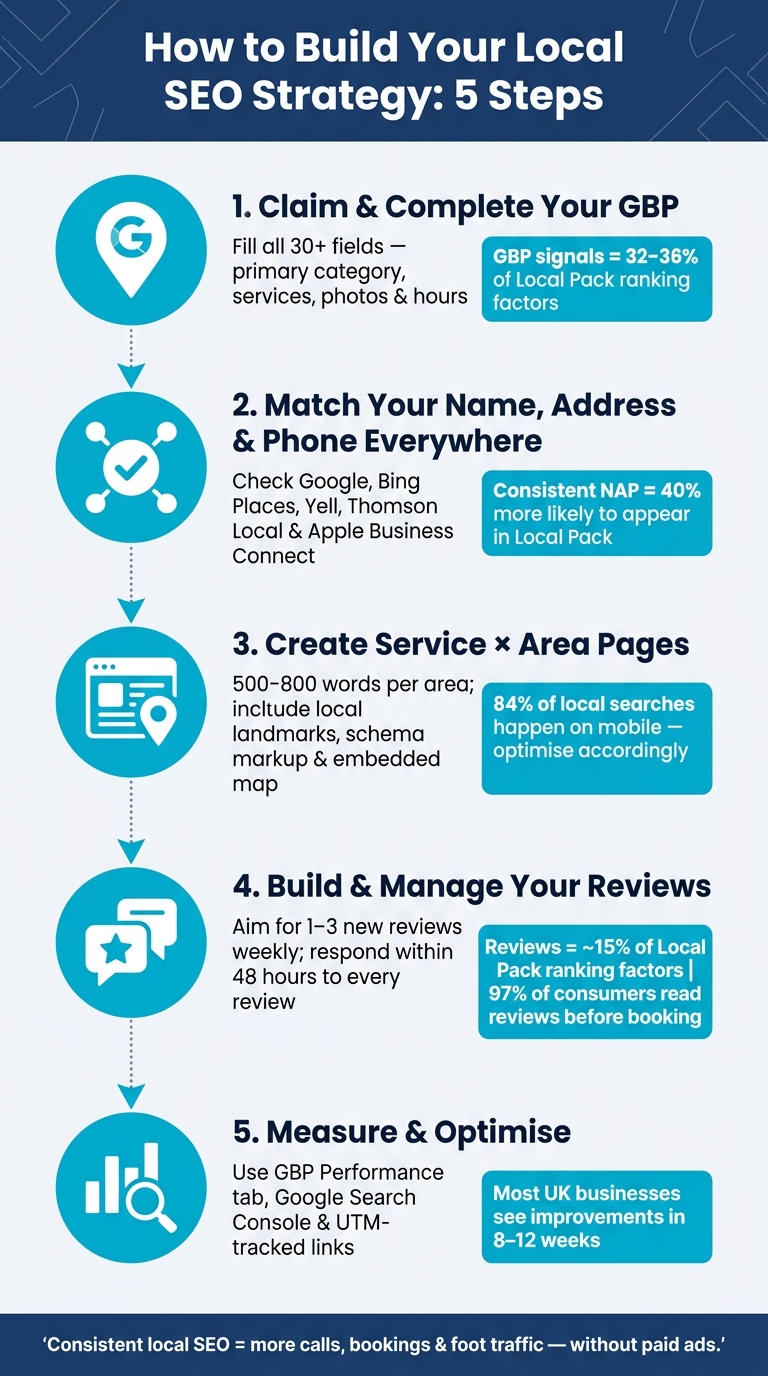
Local SEO Strategy: 5 Steps to Rank Higher in Local Search
Now that you've got an idea of what effective local SEO looks like, here’s how to build your strategy from the ground up. These steps are designed to guide you through actionable tasks that build on each other. Follow them in order for the best results.
1. Claim and Set Up Your Google Business Profile
Head over to business.google.com, claim your listing, and complete the verification process (options include postcard, phone, email, or video).
After verification, fill out every single field. Pay special attention to your primary category, as it heavily impacts rankings. For example, "Italian Restaurant" is far more effective than a generic "Restaurant". If you run a service-based business, hide your home address and instead list the areas you serve by town or postcode. Keep your profile fresh by adding new photos or posts weekly.
"Your GBP is not a static listing; it's a dynamic, living profile that needs constant engagement." - Itamar Haim, SEO Team Lead at Elementor
2. Keep Your NAP Details Consistent Across Platforms
Your Name, Address, and Phone number (NAP) must match perfectly across your website, social media profiles, and directory listings. Even small inconsistencies, like writing "Road" instead of "Rd" or using "0161" instead of "+44 161", can undermine Google's confidence in your data.
Start by Googling your business name and reviewing the first few pages of results. Look for outdated or mismatched information in directory listings and correct them, focusing on high-traffic UK platforms like Google Business Profile, Bing Places, Apple Business Connect, Yell.com, and Thomson Local. Many businesses in the UK notice local ranking improvements within 6 to 10 weeks after fixing these inconsistencies.
3. Add Location-Specific Content to Your Website
Create individual pages for each area you serve. For example, if your business operates in London, borough-specific pages (e.g., /locations/camden/) often outperform city-level ones because they target smaller, more specific audiences. Make sure each page is genuinely unique, including references to local landmarks, neighbourhood details, and real customer reviews. Avoid simply swapping out place names across otherwise identical pages, as Google tends to penalise these "doorway pages".
Each location page should feature:
- An embedded Google Map
- Consistently formatted NAP details
- LocalBusiness JSON-LD schema, with
addressCountryset to "GB" and your phone number in the +44 format
Since 84% of local searches happen on mobile, ensure these pages are mobile-friendly, load quickly, and meet Core Web Vitals standards. This approach strengthens your visibility by providing clear, geo-targeted content.
4. Ask for Reviews and Respond to Them
Make it easy for customers to leave reviews. Share a direct review link from your Google Business Profile via text, email, or even a QR code displayed in your shop or office. Aim to collect reviews steadily over time rather than in large bursts, as a sudden influx might look suspicious to Google.
Respond to every review within seven days. For positive reviews, offer a short, heartfelt thank-you. For negative ones, stay calm, acknowledge the issue, and encourage the customer to resolve it offline. Keep in mind, 89% of UK consumers read businesses' responses to reviews before making decisions.
5. Track Your Results and Make Adjustments
Use Google Search Console to find out which search terms are bringing visitors to your site, especially location-specific ones. Pair this with Google Analytics to see which pages are driving enquiries or phone calls. When posting links from your Google Business Profile, use UTM-tracked URLs to measure traffic contributions.
Rather than checking daily, review your data monthly to spot trends in impressions, conversions, and drop-off points. For most small businesses in the UK, consistent optimisation leads to noticeable improvements in local search visibility within 8 to 12 weeks.
How to Make Confident Local SEO Decisions
A Checklist of Core Local SEO Tasks
When it comes to local SEO, prioritising key tasks can make all the difference. Two major factors - Google Business Profile (GBP) completeness (32% ranking weight) and reviews (24% ranking weight) - should be at the top of your list. But local SEO isn’t a one-and-done project; it’s all about consistency. Here's a helpful breakdown of task frequency:
| Frequency | Core Action |
|---|---|
| Weekly | Post at least once on GBP; respond to all new reviews; answer recent Q&As |
| Monthly | Add 3–5 new photos; check keyword rankings; review GBP Insights |
| Quarterly | Audit citations for NAP (Name, Address, Phone) consistency; update seasonal business hours |
Why does this matter? Businesses with 50+ photos on their GBP see 520% more direction requests and 240% more website clicks compared to those with fewer than 10 photos. It’s a simple task that delivers a huge payoff.
"Local SEO in 2026 is a maintenance game, not a setup game. The businesses that hold map-pack positions are the ones feeding GBP new signals weekly." - Inzimam Ul Haq, Founder, Codivox
By sticking to these regular tasks, you’ll build a strong foundation. From there, you can use performance data to fine-tune your strategy.
How to Use Data to Measure Your Progress
Once you’ve got the basics covered, tracking customer interactions is the next step to understanding your progress.
Start with the GBP Performance tab. Keep an eye on key metrics like calls, direction requests, and website clicks - these "action rates" show real customer interest, unlike raw view counts.
For your website, focus on organic traffic to location-specific pages. Track conversions, such as enquiry form submissions, calls, or bookings. To differentiate local traffic from general visitors, add a UTM parameter to your GBP website link (e.g., ?utm_source=google&utm_medium=gbp) and analyse it in Google Analytics.
Discovery searches are another useful metric. These occur when users find your business through service or category searches. If discovery searches are rising, it’s a good sign your local SEO efforts are paying off. However, if impressions are increasing but actions aren’t, it’s time to improve your photos, gather more recent reviews, or revisit your primary category selection.
"Google's algorithm has more of a 'what have you done for me lately?' attitude [regarding reviews]." - Elizabeth Rule, Local SEO Analyst
For businesses operating across multiple postcodes, geo-grid tracking tools like BrightLocal or Local Falcon are invaluable. They provide a visual map of your rankings by area. For instance, you might rank in the top three within your immediate postcode but drop to position ten just two miles away. Without these tools, spotting such patterns would be nearly impossible.
Conclusion: What UK Small Businesses Should Take Away
Local SEO is your direct line to customers who are ready to act. With 46% of all Google searches having local intent and 76% of local smartphone searches leading to a business visit within 24 hours, this isn’t just about visibility - it’s about being the business that customers choose when they’re ready to make a decision.
The formula for success isn’t complicated or budget-heavy. It’s about staying consistent. Focus on optimising your online presence, ensuring your business details are accurate across platforms, tailoring your website content to local audiences, and building up genuine customer reviews. These small yet steady actions make a big difference.
As Want SEO puts it:
"The businesses that understand what is local SEO and invest in it consistently are the ones that show up first, get called first, and grow fastest in their local markets." - Want SEO
Unlike paid ads, local SEO works like a snowball. Every review, every photo, and every location-specific update boosts your online visibility without the recurring costs of pay-per-click campaigns. Over time, this creates a compounding effect that delivers long-term growth.
For UK small businesses ready to take the leap, The Catalyst Method offers a tailored local SEO service for £500 per month, designed to help you implement the structured, consistent approach outlined here.
FAQs
How long does local SEO take to work?
Local SEO tends to show early progress within 4–8 weeks, with more noticeable ranking improvements usually appearing after 2–3 months. You might see quicker results from tasks like optimising your Google Business Profile, but establishing a solid local presence often requires 6–12 months of consistent effort. How fast you see results largely depends on factors like the level of local competition and your ongoing efforts, such as publishing content and collecting customer reviews.
Do I need a shop address to rank locally?
To rank locally, having a customer-facing shop isn't a requirement. However, you do need a verifiable physical address to create a Google Business Profile. If you're running a service-area business, you can use an address for verification purposes and choose to hide it from public view if necessary. Keep in mind, proximity to searchers remains a crucial factor in local rankings, so your physical location still has significant influence.
What should I track to measure local SEO results?
To gauge the success of your local SEO efforts, start by keeping an eye on Google Business Profile (GBP) metrics. These include key actions like phone calls, website clicks, and requests for directions - valuable indicators of how users are engaging with your business.
Next, monitor your local rankings and search visibility using tools like Google Search Console. This helps you understand how often your business appears in relevant local searches.
Don’t overlook your online reputation. Pay attention to metrics such as the total number of reviews, your average star rating, and how quickly you respond to customer feedback. These factors not only influence potential customers but also affect your local SEO performance.
Lastly, tie these metrics to real business outcomes. Use your CRM or point-of-sale system to track inbound calls and new customer acquisitions, giving you a clearer picture of how your SEO efforts are driving growth.