Local seo for business: The Complete 2026 Guide for UK Small Businesses
Local SEO is a must for UK small businesses in 2026. With nearly half of Google searches having local intent and “near me” searches up by 52% year-on-year, it’s clear that customers are actively seeking local services. Here's what you need to know:
- Google Business Profile (GBP): Essential for visibility. Claim or create your profile, choose a specific category, maintain accurate details, and upload at least 30 photos for better engagement.
- NAP Consistency: Ensure your Name, Address, and Phone number are uniform across all platforms like Yell, ThomsonLocal, and Apple Business Connect. Even small inconsistencies can harm rankings.
- Website Optimisation: Add NAP details to your site, use LocalBusiness schema, optimise for mobile, and create dedicated service and location pages.
- Local Content: Write blogs or FAQs addressing local issues and queries to strengthen your authority and relevance.
- Reviews and Citations: Generate steady reviews and maintain accurate listings on key directories. Consistency builds trust with Google and customers.
- Local Backlinks: Earn links from regional sources like local newspapers, councils, or community organisations.
Tracking performance is just as important. Tools like Google Business Profile Insights, Google Search Console, and geo-grid rank trackers can help monitor your progress. Consistently updating your listings and content ensures you stay ahead in local search results.
Local SEO For Beginners (2026 Complete Guide)
sbb-itb-6d98f47
Building the Foundation for Local Search Success
Understanding the importance of local SEO is one thing, but putting it into action is where the real work begins. The good news? The essential steps are straightforward, and most won’t cost you a penny.
Setting Up Google Business Profile (GBP)
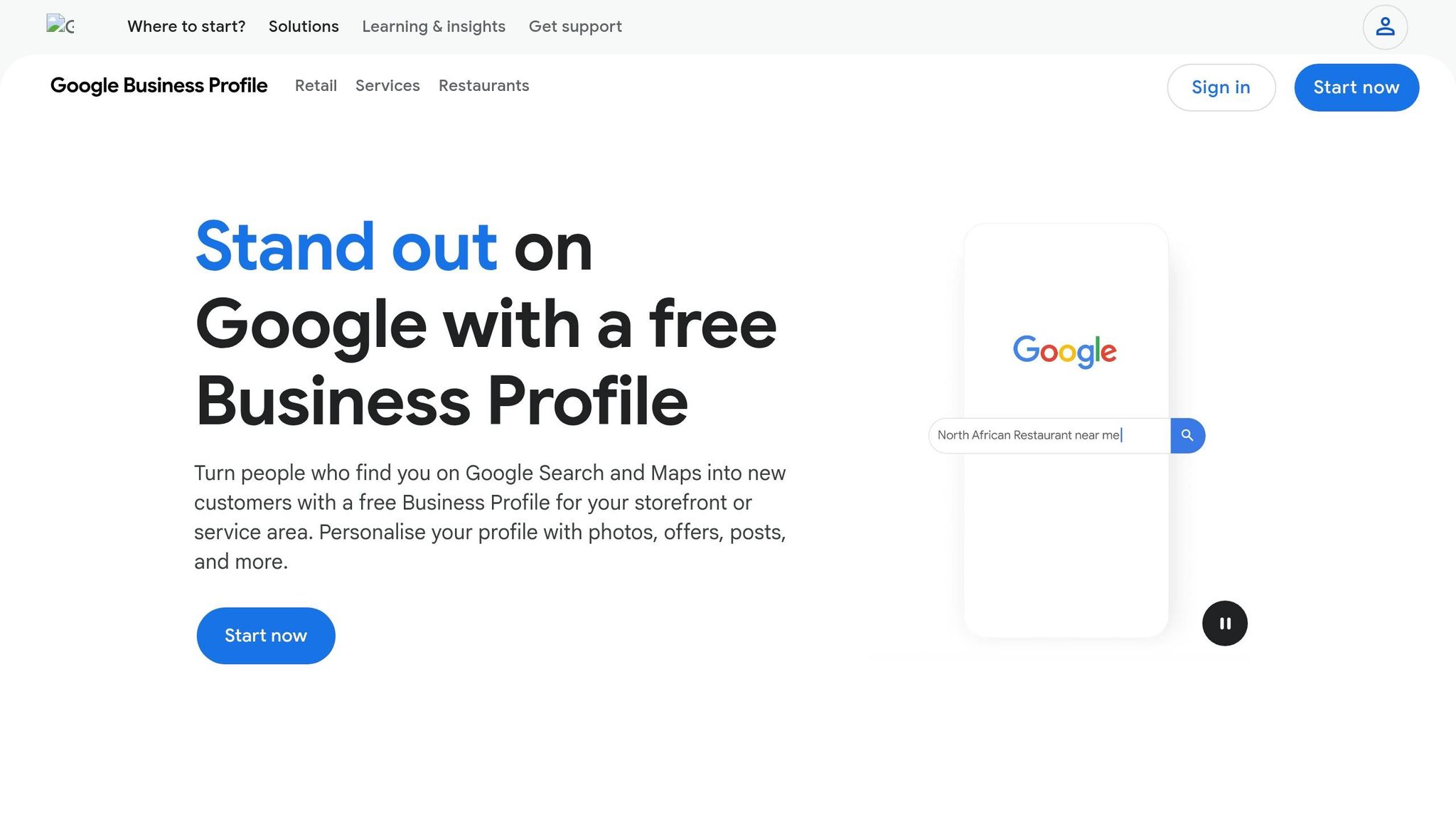
Your Google Business Profile (GBP) is hands-down the most critical tool for local SEO. Why? GBP signals make up approximately 36% of local pack ranking factors, and having a complete profile can get you 7 times more clicks than an incomplete one.
To get started, head to Google Business Profile and search for your business. If it’s already there, claim it. If not, create a new profile. Verification usually takes 5–14 business days via postcard, though in the UK, Google might ask for a video walk-through or proof like a branded van.
Choose your primary category carefully - go for the most specific option.
"Your primary category is the most influential ranking signal within your Google Business Profile." - Anthony Barone, SEO Specialist, StudioHawk
For example, instead of using "Legal Services", opt for "Family Law Solicitor". Also, make sure your business name matches your offline branding exactly - no sneaky keyword stuffing.
"Ensure your business name exactly matches your offline branding." - Google Business Profile Help
Adding something like "Emergency Plumber London" to your business name might seem clever, but it violates Google's rules and could get your profile suspended.
Don’t forget to upload at least 30 photos of your business - include shots of the exterior, interior, team, and even work in progress. Profiles with 30+ photos see 35% more clicks to their website. Also, keep your Special Hours updated for UK bank holidays to avoid unhappy customers and negative reviews.
If you’re a service-area business (SAB) - like a plumber or mobile therapist - hide your home address. Instead, define up to 20 service areas by city or postcode, keeping them within a two-hour driving radius.
Keeping NAP Consistent Across Platforms
Your Name, Address, and Phone number (NAP) must be consistent across all online platforms. Even small differences, like abbreviations or formatting, can confuse Google and hurt your rankings.
"If Google is getting conflicting data about your business from multiple sources, it lowers its trust in your data." - Darren Shaw, Founder of Whitespark
Businesses with consistent NAP data across major directories are 40% more likely to appear in the Google Local Pack. Yet, a staggering 90% of UK businesses have inconsistent NAP details across their online presence.
Start by creating a master record of your business details, then update your information on key platforms in this order:
- Tier 1 (Core): Google Business Profile, Bing Places, Apple Business Connect, Yell.com, ThomsonLocal, FreeIndex, Scoot, 192.com
- Tier 2 (General): Hotfrog UK, Yelp UK, Bizify, Touch Local, Brownbook
- Tier 3 (Industry): Checkatrade, Rated People (Trades); Law Society (Legal); TripAdvisor (Hospitality)
Always include the space in UK postcodes (e.g., SW1A 1AA) and use a local landline number if possible. A local number signals a stronger presence than a mobile or 0800 number. Audit your listings annually to fix any discrepancies. Once updated, expect to see improvements in Local Pack rankings within 6 to 12 weeks.
Making Your Website Ready for Local SEO
With your GBP and NAP details sorted, your website should reinforce these signals to boost your local SEO. Start by adding your NAP to the footer of every page and embedding a live Google Map on your Contact page.
Next, implement LocalBusiness JSON-LD schema markup. This structured data provides search engines with a clear, machine-readable version of your business details. Be sure to set the addressCountry field to "GB" and format your phone number with the +44 prefix. This helps your business appear in AI Overviews, which now show up in about 40% of local business queries.
Mobile optimisation is critical. Over 60% of local searches are done on mobile, and nearly half of users will abandon a site that takes longer than 3 seconds to load. Aim for a load time under 2 seconds and include prominent click-to-call buttons so potential customers can contact you easily.
Optimising Website Content for Local Visibility
How to Do Local Keyword Research
Once your online presence is established, the next step is to sharpen your website's visibility with well-planned local keyword research. This type of research focuses on intent, location, and relevance.
A good starting point is the Service + Location formula. For example, phrases like "boiler repair in Leeds" or "family solicitor Manchester" work well. From there, consider user intent: transactional keywords such as "emergency locksmith Bristol" are better suited for service pages, while informational ones like "cost of boiler repair Leeds" fit naturally into blog posts or FAQ sections.
Tools like Google Business Profile Insights can show you the exact searches people use to find your listing. Similarly, Google Search Console allows you to export your top queries, including "near me" and postcode-specific searches. For more in-depth research, platforms like Ahrefs, SEMrush, and BrightLocal can help identify keyword gaps that your competitors may have overlooked.
In highly competitive areas such as London, broad city-level keywords can be tough to rank for. Instead, narrow your focus to borough-level keywords like "accountant in Camden" rather than "accountant in London." This approach is particularly effective given that "near me" searches in the UK have increased by over 400% since 2022.
Once you've gathered your targeted keywords, the next step is to highlight your services and local expertise through dedicated pages.
Creating Service and Location Pages
For each key service and location, create a dedicated page (e.g., /services/boiler-repair-reading or /locations/camden/family-solicitor). This "Service × Area" strategy directly targets long-tail queries and avoids the pitfalls of vague "Areas We Cover" lists.
It's essential to avoid doorway pages. Every location page should feature unique, area-specific content. Google's spam detection systems penalise pages that use near-identical templates with only the town name swapped out. To make your pages stand out, include elements like local customer testimonials, references to nearby landmarks or council regulations, and genuinely helpful information for residents in that area. Properly crafted location-specific pages can generate 3 to 5 times more conversions than a generic homepage.
Each page should follow a clear structure. Start with a straightforward introduction that highlights the service, the area, and what customers can expect. Include details about sub-services, local proof such as photos and testimonials, trust signals like UK certifications or insurance, and a visible click-to-call button. Embedding a Google Map and adding LocalBusiness JSON-LD schema with the addressCountry: "GB" field is also important - this is a commonly overlooked UK-specific requirement.
Beyond these pages, publishing regular local content can further strengthen your presence.
Writing Locally Relevant Content
To enhance your authority, complement your Google Business Profile and NAP (Name, Address, Phone) consistency with regular content tailored to local queries. Aim to publish 2–4 pieces of content each month, focusing on practical topics related to your services. Examples include "What to Ask a Plumber Before Hiring in Manchester" or "How Much Does a Loft Conversion Cost in Bristol in 2026?".
These pieces should directly address local issues. Generic content won’t make an impact. Referencing elements like local infrastructure, regional pricing trends, or area-specific building styles demonstrates both to readers and search engines that you have genuine expertise in the area. This is increasingly important, as AI Overviews now appear in approximately 40% of local business searches. As John Carey, an SEO Consultant, puts it:
"The businesses most likely to be cited by AI systems are those with well-structured websites, consistent citation profiles, and clear service information."
When structuring your content, get to the point quickly - answer the main question early on. This "answer-first" approach increases your chances of appearing in AI Overviews and capturing the 64% of clicks that go to the Google Local Pack.
Building Local Authority with Reviews, Citations, and Backlinks
Getting and Managing Customer Reviews
Google reviews play a big role in Local Pack rankings, influenced by factors like the number of reviews, how recent they are, and whether they include relevant keywords. A steady stream of reviews suggests ongoing activity, but a sudden spike followed by inactivity can actually hurt your ranking.
If you're asking customers for reviews, it's important to follow UK regulations, including ICO and PECR guidelines. For instance, if you're using automated emails or SMS to request reviews, you must have prior consent and include a clear way for recipients to opt out. Responding to reviews - whether they’re glowing or critical - shows that you value feedback and helps build trust with potential customers.
In addition to reviews, keeping your online citations accurate and consistent further boosts your local authority.
Building and Maintaining Local Citations
A citation is any mention of your business’s name, address, and phone number (NAP) online. Consistency across all platforms is critical. As Anthony Barone, SEO Specialist at StudioHawk, puts it:
"NAP consistency refers to having identical name, address, and phone number details across every online directory... Inconsistencies confuse Google and reduce the confidence the algorithm has in your business data."
Google uses an entity confidence score to determine how reliable your business information is. The more consistent your NAP details are across directories, the higher your score - and better rankings follow. Even small details, like formatting your postcode or phone number uniformly, matter.
For most UK small businesses, having 15–25 accurate listings on the right platforms is enough. Focus on quality rather than quantity by prioritising key platforms through a tiered approach:
| Citation Tier | Platform Examples | Why It Matters in 2026 |
|---|---|---|
| Tier 1: Foundational | Google Business Profile, Bing Places, Apple Business Connect | Core platforms for rankings; essential for Maps and voice search |
| Tier 2: Major UK | Yell.com, Thomson Local, FreeIndex, Foursquare | High-authority platforms; Foursquare data influences over 70% of ChatGPT's local recommendations |
| Tier 3: Industry-Specific | Checkatrade (trades), TripAdvisor (hospitality), Law Society (legal) | Adds credibility within your sector and provides relevant links |
| Tier 4: Local/Regional | Local council (.gov.uk) directories, Chambers of Commerce | Strengthens geographic trust signals unique to your area |
To streamline this process, create a "canonical NAP" document that includes your exact business name (as registered with Companies House), address, and phone number. Use this document to copy and paste your details into directories instead of typing them manually. It’s also wise to set a quarterly reminder to review listings for unauthorised edits, as Google may update your information based on user suggestions.
Earning Local Backlinks
Once reviews and citations establish your local credibility, local backlinks can further boost your online presence.
For organic rankings in local search results, link signals contribute about 15% of the ranking weight for results below the Map Pack. The key is geographic relevance - links from local sources, like the Manchester Evening News or a Cheshire-based .org.uk domain, carry more weight for a local business than links from high-profile national sites.
"Local link building is not simply link building done in your home market. It is a distinct discipline grounded in... geographic relevance." - Perwez Alam, Link Building Specialist
Sponsoring local events or joining community organisations can help you earn these valuable backlinks while supporting your local area. For example, joining the Federation of Small Businesses (FSB) or your local Chamber of Commerce (membership fees range from £150–£600 per year) provides a relevant, followed link from a trusted domain. For certain industries, professional accreditations like NICEIC for electricians or RIBA for architects offer authoritative links that competitors without those credentials can’t easily replicate.
A practical example highlights how effective this strategy can be. Between March 2025 and February 2026, a family law firm in Bristol improved its Domain Rating from 18 to 36 and quadrupled its organic enquiries. Their strategy included pitching a legal story to Bristol Live, sponsoring a Clifton primary school fete for £250, and winning a category at the West of England Business Awards. If your business operates in multiple locations, tailor this approach for each branch. For instance, a link from a Derby charity should point to your Derby-specific landing page rather than your homepage.
These steps - reviews, citations, and local backlinks - work together to strengthen your local search performance over time.
Measuring, Maintaining, and Growing Your Local SEO
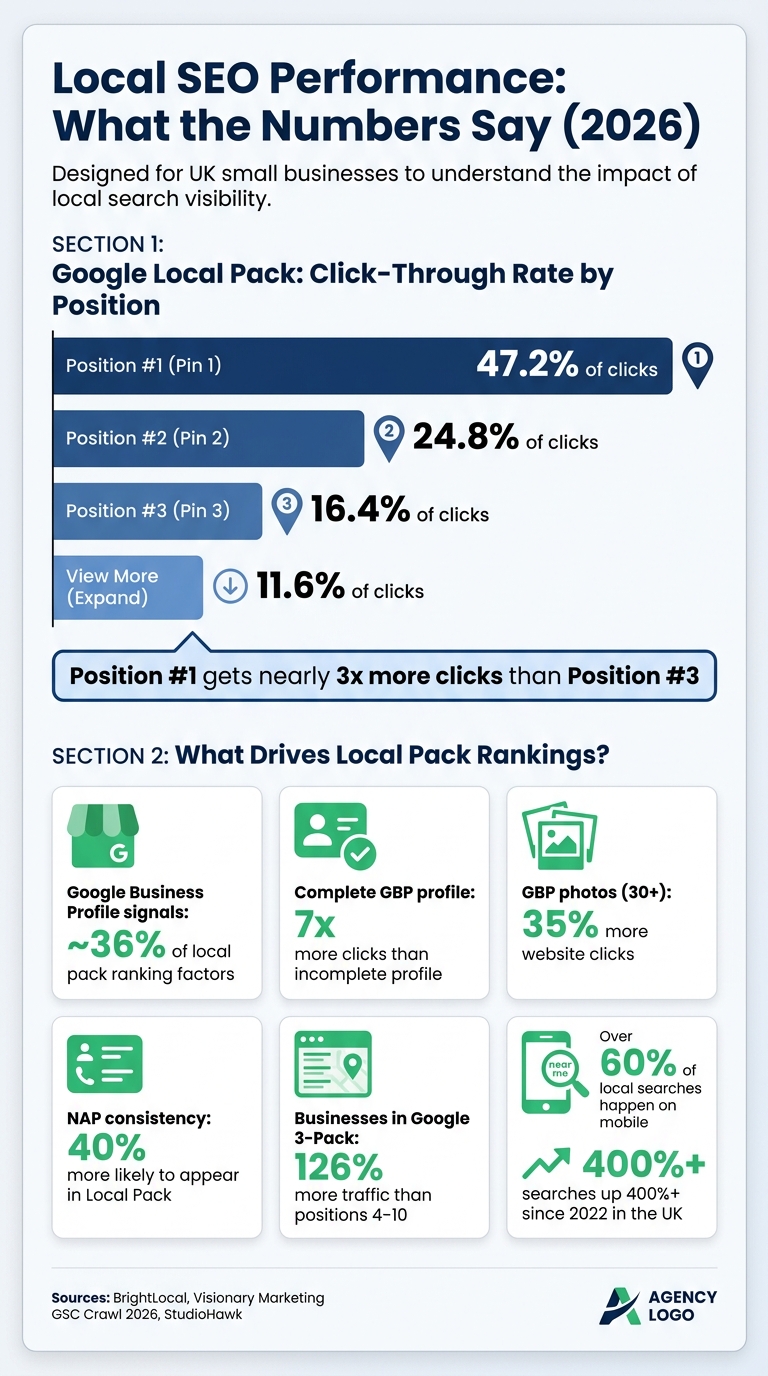
Local Pack Click-Through Rates & Key Local SEO Ranking Factors 2026
Key Local SEO Metrics to Track
Once you've set up your review, citation, and backlink strategies, the next step is keeping tabs on your local SEO performance. Use tools like the GBP Performance dashboard and Google Search Console to track key actions like calls, clicks, direction requests, and local intent queries. The good news? Local SEO is one of the easiest marketing channels to measure.
"Local search is the rare digital marketing channel where the click-to-action conversion is measurable in feet, not metrics." - Chris Coussons, Founder, Visionary Marketing
Your Local Pack position plays a huge role in visibility. Here's why: the first position captures 47.2% of all local-pack clicks. Compare that to 16.4% for the third position, and you can see how even a small ranking drop can significantly affect enquiries. If you notice a decline in direction requests, it could be a sign of an issue, like a NAP inconsistency, especially after a business move or listing update.
| Local Pack Position | Click-Through Rate (CTR) |
|---|---|
| Pin #1 | 47.2% |
| Pin #2 | 24.8% |
| Pin #3 | 16.4% |
| "View More" (Expand) | 11.6% |
(Source: Visionary Marketing GSC Crawl 2026)
These numbers highlight the importance of maintaining or improving your ranking. A drop in position directly impacts the volume of enquiries your business receives.
To dig deeper into performance, use tools like GA4 or a CRM to attribute leads to specific pages or locations. If a page has high impressions but low clicks, it might mean your title or meta description isn't resonating with local searchers.
Tools to Monitor Your Local SEO Performance
Tracking local SEO doesn't require an elaborate tech setup. A few key tools can handle most of what small UK businesses need.
Start with GBP Performance and Google Search Console - both are free and offer essential insights. To visualise your rankings geographically, tools like BrightLocal or LocalHQ use geo-grid rank tracking. This method shows how your business ranks across specific postcodes, giving a clearer picture than a single average ranking.
For businesses wanting an all-in-one solution, The Catalyst Method offers a lead generation dashboard and CRM for £500/month. This service simplifies tracking by showing which pages and locations generate leads without having to juggle multiple platforms.
Another tip? Keep a change log to record updates. This helps you link changes to performance shifts and ensures you're always improving.
Keeping Listings and Content Up to Date
Regular updates to your Google Business Profile (GBP) can significantly boost your local SEO. Google's algorithm favours businesses that remain active over those that go dormant.
"Treating your Google Business Profile as a living, managed asset rather than a one-time task is the mindset shift that separates businesses that dominate local search from those that barely appear." - Anthony Barone, SEO Specialist
Here’s a practical schedule to follow:
- Weekly: Respond to reviews and post updates.
- Monthly: Review new search queries.
- Quarterly: Conduct a technical audit. This includes fixing broken links, validating your LocalBusiness schema using Google's Rich Results Test, and checking NAP consistency across Tier 1 directories.
Adding fresh photos to your GBP is another simple yet effective tactic. Upload four to five new images each month to keep your profile engaging and relevant.
The key to growing your local presence isn't about doing something extraordinary. It's about being consistent. Small, regular updates and actions build up over time, giving you a steady edge over competitors who set up their profiles once and then forget about them.
Conclusion: Achieving Local SEO Success with The Catalyst Method
Key Points Recap
Throughout this guide, we've seen that local SEO in 2026 doesn't require complex tactics. Instead, it’s about consistently nailing the basics. As SEO Consultant John Carey aptly states:
"The businesses that dominate local search results in their area aren't doing anything secret; they're doing the fundamentals consistently and well."
Here’s a quick rundown of the strategies that matter most:
- Google Business Profile: This remains the most influential ranking factor, contributing around 32% to Local Pack rankings.
- NAP consistency: Ensuring your business name, address, and phone number are accurate and uniform across platforms like Yell, ThomsonLocal, and Apple Business Connect.
- Reviews: Generating a steady flow of three to five authentic reviews monthly to build trust and credibility.
- Location pages: Creating unique, evidence-based pages that target specific services and geographic areas.
- Local backlinks: Securing links from reputable regional sources, such as local newspapers and council websites.
These efforts collectively lead to real results. Businesses featured in Google’s 3-pack enjoy 126% more traffic than those ranked between positions four and ten. This translates directly into higher footfall and increased revenue.
By focusing on these core elements, you set the foundation for a robust local SEO strategy that delivers tangible growth.
How The Catalyst Method Can Help
Achieving consistent, measurable results from local SEO often requires expert support. That’s where The Catalyst Method steps in - a local SEO and lead generation service designed specifically for UK businesses.
For £500 per month, The Catalyst Method offers a comprehensive package, including website creation, keyword optimisation, Google rankings, local content and blogs, a lead magnet, and a CRM with email automation. It also provides a lead generation dashboard to help you identify which pages and locations drive the most enquiries.
James Wright, Head of SEO at Prism Digital Group, sums it up perfectly:
"Local SEO is not a one-time project - it is an ongoing process of optimisation, content creation, and reputation building."
This ongoing effort is exactly what The Catalyst Method handles, allowing you to focus on running your business while your local visibility and leads grow steadily.
FAQs
How long does local SEO take to work?
Local SEO progress tends to unfold in phases. Within the first 2 to 6 weeks, businesses often see initial indicators, such as updates to their Google Business Profile or an increase in impressions. However, it usually takes 60 to 90 days of steady effort to observe measurable improvements. For more noticeable outcomes, a timeline of 3 to 6 months is common. In fiercely competitive markets, achieving results can extend to 6 to 12 months or longer, depending on the level of competition and the quality of your foundational setup.
What should I do if my Google Business Profile gets suspended?
If your Google Business Profile gets suspended, don’t panic. The key is to avoid making any edits while the profile is flagged, as this could be seen as an attempt to bypass the issue. Start by reviewing Google’s guidelines carefully to pinpoint potential problems. Common issues include keyword stuffing, incorrect address information, or duplicate profiles.
Once you've identified and corrected any violations, submit a reinstatement request using the official support form. Make sure to include a clear explanation of the changes you've made and provide evidence to confirm your business's legitimacy. This will help speed up the process and improve your chances of getting the profile reinstated.
Do I need separate pages for every town I serve?
Most small businesses in the UK tend to achieve better results by focusing on well-crafted service pages and an "areas we cover" hub. Creating town-specific pages is only worthwhile if you can include unique local information and credible proof that sets each page apart. Avoid the temptation to churn out nearly identical pages where only the town name changes - Google often flags these as spam. For businesses operating from a single location, your homepage, along with detailed About and Contact pages, is usually enough to cover your bases.