Local seo for business Explained in Plain English
Local SEO helps businesses show up in Google searches for local customers. It’s about making sure your business appears when people search for services near them, like "plumber in London" or "dentist near me." Why does it matter? Because 46% of Google searches are local, and 76% of people who search for nearby services visit a business within 24 hours. If you’re not optimising for local search, you’re missing out on potential customers.
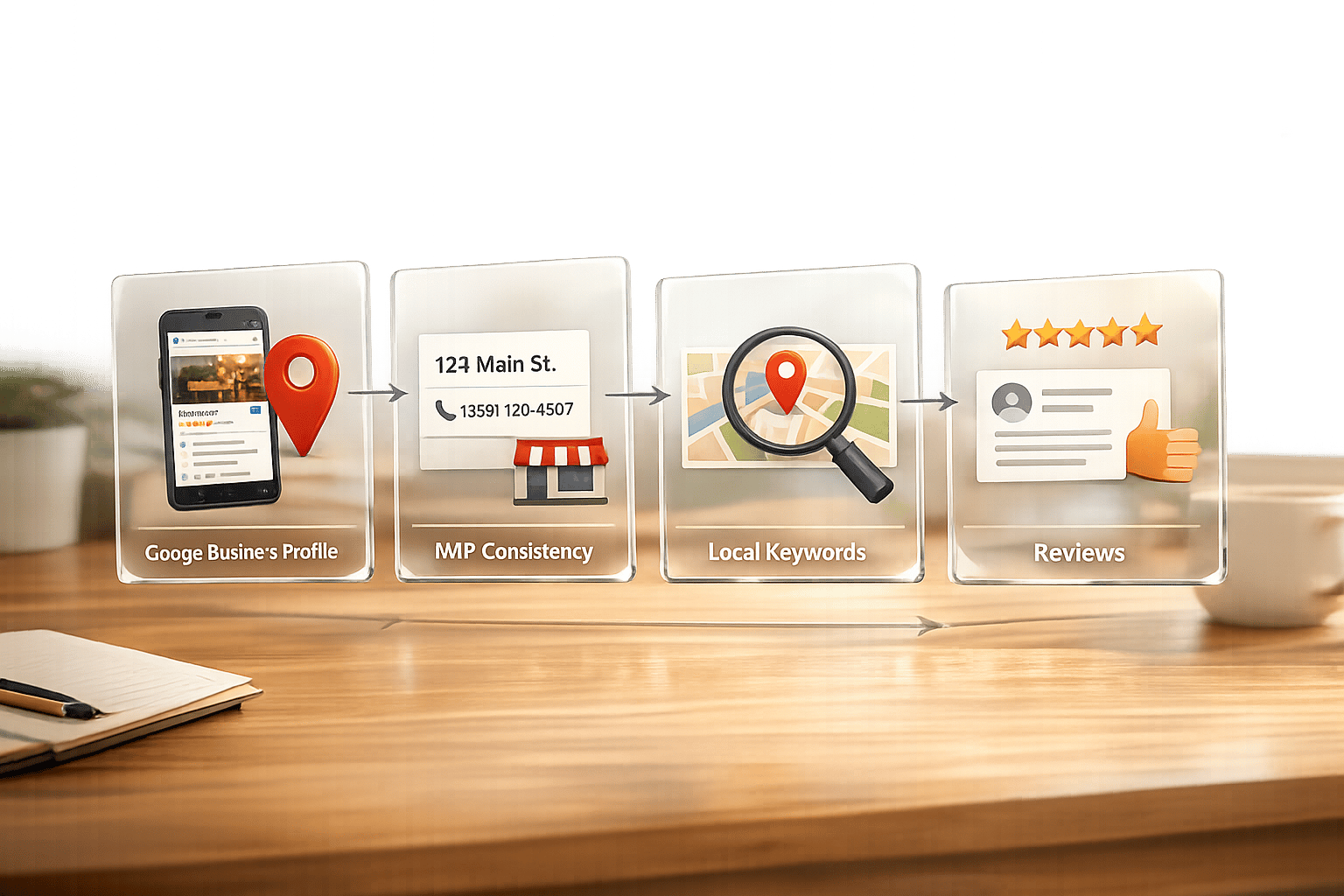
Here’s what you need to do to improve your local SEO:
- Set up and optimise your Google Business Profile (GBP): Claim it, verify it, and keep it updated with accurate details, photos, and posts.
- Keep your NAP (Name, Address, Phone number) consistent: Use the same format everywhere online to avoid confusing Google.
- Target location-specific keywords: Include your service and location in your website content, like “electrician in Manchester.”
- Get listed in local directories: Platforms like Yell.com and Thomson Local build trust with Google and customers.
- Encourage customer reviews: Reviews boost visibility and trust. Respond to them quickly, whether they’re good or bad.
Local SEO focuses on relevance (matching searches), distance (proximity to the searcher), and prominence (how trustworthy your business looks online). By following these steps, small businesses can compete with larger ones and attract more local customers.
Let’s break it down further into actionable steps.
Local SEO For Beginners (2026 Complete Guide)
Local SEO Basics in Plain English
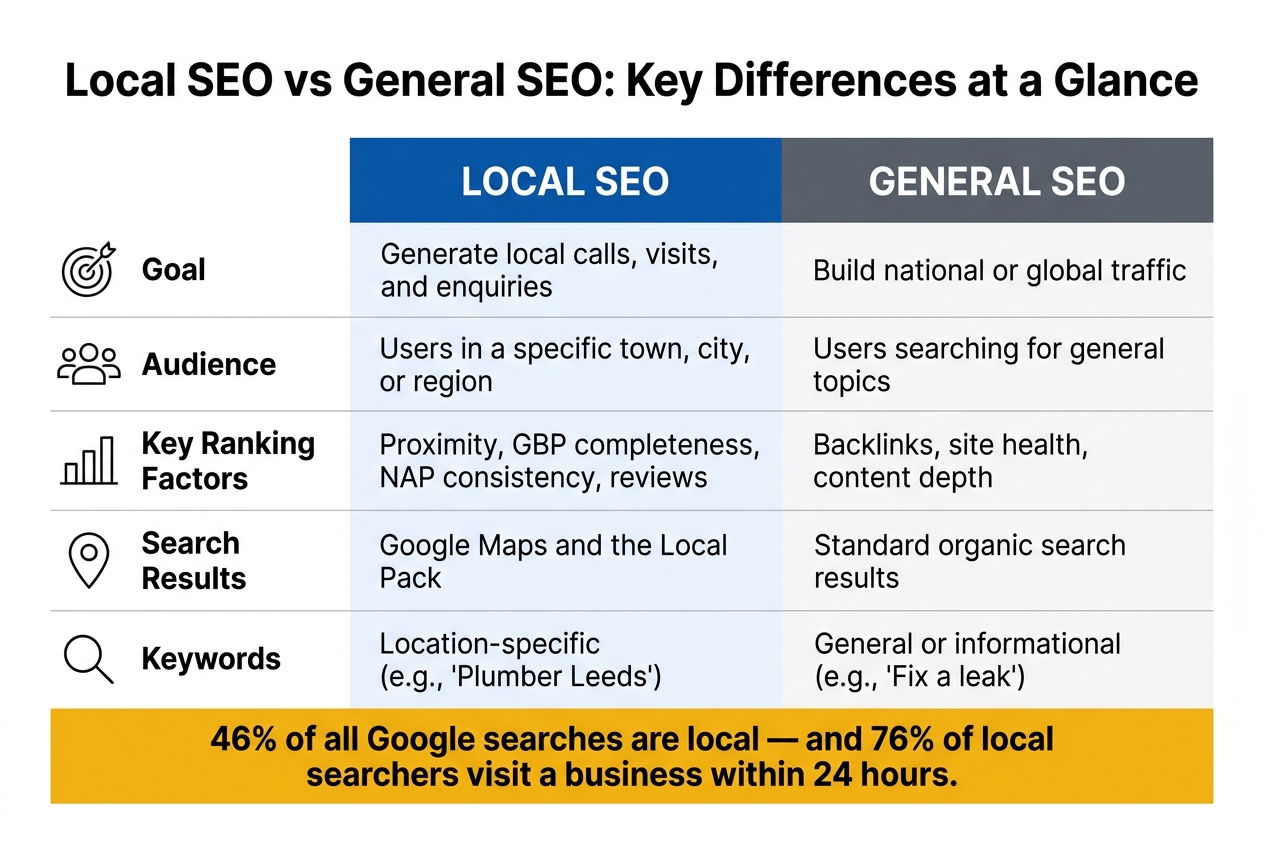
Local SEO vs General SEO: Key Differences at a Glance
How Local SEO Works
Let’s break down how local SEO functions in everyday terms. Imagine Google as a digital concierge. When someone searches for "electrician in Leeds", Google quickly analyses its database of local businesses and selects the ones it trusts to address the searcher's needs. This selection process revolves around three main factors: relevance, distance, and prominence.
- Relevance measures how closely your business profile matches the search query.
- Distance considers how physically close your business is to the searcher.
- Prominence is about how well-known and credible your business seems, based on factors like customer reviews, directory listings, and backlinks.
Interestingly, signals from your Google Business Profile (GBP) alone influence 32% of local pack rankings. Grasping these concepts is key to understanding the backbone of local SEO.
"Google doesn't reward the business with the fanciest website. It rewards the business it can verify with confidence." - Bare Digital
Key Terms You Need to Know
Here are some essential terms to help you navigate local SEO:
- Google Business Profile (GBP): This free tool lets your business show up on Google Search and Maps.
- Local Pack (or 3-Pack): The prominent box at the top of Google’s search results that highlights three businesses alongside a map.
- NAP (Name, Address, Phone number): These details need to be consistent across all platforms. Even minor inconsistencies - like using "St" instead of "Street" - can lower your visibility by up to 28%.
- Citations: These are mentions of your business’s NAP on external websites, such as directories. In the UK, platforms like Yell.com, Thomson Local, FreeIndex, and 192.com are key.
- Reviews: Customer feedback plays a big role in building trust with both users and Google, boosting your prominence score.
Next, let’s explore how local SEO is different from general SEO and why it deserves a dedicated approach.
Local SEO vs. General SEO: What's the Difference?
General SEO focuses on ranking for broader topics, like "how to fix a leaking tap", without considering where the user is located. Local SEO, on the other hand, zeroes in on people searching within a specific area and aims to drive immediate action, like calls or visits.
| Feature | Local SEO | General SEO |
|---|---|---|
| Goal | Generate local calls, visits, and enquiries | Build national or global traffic |
| Audience | Users in a specific town, city, or region | Users searching for general topics |
| Key Ranking Factors | Proximity, GBP completeness, NAP consistency, reviews | Backlinks, site health, content depth |
| Search Results | Google Maps and the Local Pack | Standard organic search results |
| Keywords | Location-specific (e.g., "Plumber Leeds") | General or informational (e.g., "Fix a leak") |
"For a local business, ranking in the local pack is often more commercially valuable than ranking first in the regular organic results." - John Carey, SEO Consultant
The key takeaway here? If your business caters to customers in a specific area, local SEO should be at the top of your to-do list.
Setting Up the Basics of Local SEO
How to Set Up and Optimise Your Google Business Profile
Your Google Business Profile (GBP) acts as your digital shopfront on Google Search and Maps. Getting it right can make a big difference: businesses with complete profiles are twice as likely to be seen as reputable and receive seven times more clicks than those with incomplete listings.
Here’s how to optimise your GBP:
- Claim and verify your profile immediately. Since 2026, Google has required a short video (about 30 seconds) for verification. This video should showcase your premises, signage, and proof of access. Without verification, your profile lacks credibility.
-
Pick the right primary category. This is a key factor in how Google ranks your business.
"The primary category is the most significant optimisation lever in your GBP listing. Google uses it to determine which searches your listing is eligible to appear for." - Liam Hayward, SEO Specialist, The SEO Handbook
Be specific. For instance, "Boiler Installation Engineer" will perform better than the broader "Plumber" for targeted searches. Also, stick to your exact legal trading name. Adding keywords like "Best Plumber Manchester" violates Google’s guidelines and could lead to suspension. - Add photos. Profiles with at least 30 photos get 35% more clicks than those with fewer. Include pictures of your premises, team, and completed projects. If you're a service-area business (e.g., a mobile electrician), hide your home address and instead define up to 20 service areas by town or postcode.
- Stay active. Regular updates matter. Post weekly, respond to reviews within 48 hours, and use the Q&A section to address common customer queries. This signals to Google that your business is active and engaged.
Lastly, ensure your NAP (Name, Address, Phone number) details are consistent across all platforms.
Keeping Your NAP Details Consistent
Just as your GBP needs to be accurate, your NAP details must be consistent across every online mention of your business. Google cross-references this information to determine the reliability of your listing.
"Your profile is frequently your most visible online asset, outranking your own website in terms of immediate consumer engagement." - Anthony Barone, SEO Specialist, StudioHawk
Here’s how to handle it:
- Create a "canonical NAP" document with your exact business name, UK-formatted address (including house number, street, town, county, and postcode), and phone number in the +44 format. Use this as your reference for every online listing.
- Use tools like BrightLocal or Whitespark to scan for inconsistencies. These tools can identify variations in your details across directories. Once spotted, prioritise corrections in this order:
| Tier | Platforms | Why It Matters |
|---|---|---|
| Tier 1: Core | GBP, Bing Places, Apple Business Connect, Yell, ThomsonLocal | These are the primary platforms and data aggregators. |
| Tier 2: General | Hotfrog UK, Yelp UK, Bizify, Touch Local, Scoot | Adds extra data points and backlinks. |
| Tier 3: Industry | Checkatrade (trades), Law Society (legal), TripAdvisor (hospitality) | Boosts trust and relevance within specific sectors. |
Building a Website That Supports Local SEO
With your GBP and NAP sorted, your next step is ensuring your website is optimised for local SEO. Your website acts as another key signal for Google, reinforcing your local presence.
To make your website work for local SEO:
- Use LocalBusiness schema. This structured data (in JSON-LD format) helps Google understand your business. For UK businesses, set the
addressCountryto"GB"and format your phone number in the+44style. Even if you display a local number (e.g., 020 7946 0958) for visitors, the backend code should include the international format. - Display your NAP consistently. Include it in the footer of every page and on your contact page. Ensure it matches your GBP exactly, down to details like "Street" vs "St." Adding a Google Maps iframe to your contact page also reinforces your location.
- Create location-specific pages. If you serve multiple areas, build separate pages for each town or city. Include unique content, such as local testimonials, nearby landmarks, or photos of completed jobs. Avoid using identical templates - Google requires at least 30–50% unique content on each page.
"Your website's technical health has a direct impact on local rankings, and it's the factor most local businesses neglect because it's not visible in the same way as a GBP listing." - John Carey, SEO Consultant
Given that 84% of local searches happen on mobile, your website must load quickly and look great on smartphones. Use Google Search Console to monitor your Core Web Vitals, which measure site speed and stability, and address any flagged issues without delay.
Local SEO Strategies You Can Act On
How to Use Location-Based Keywords
One of the most straightforward ways to connect with local customers is by combining what you offer with where you offer it. For example, phrases like "family solicitor in Cambridge" or "emergency plumber in Manchester" clearly signal to Google who your business serves and where. This matters because 28% of local searches lead to a purchase within 24 hours.
To stand out even more, try targeting hyper-local terms. Instead of just focusing on major city names, include specific postcodes, such as "electrician M20". This approach can help you rank higher for searches that bigger competitors might miss. Make sure to weave these keywords naturally into your website’s key areas, like page titles, headings, meta descriptions, and image alt text. Avoid overloading your content with keywords, as this can backfire. Additionally, creating location-specific landing pages can be a game-changer - these pages often convert three to five times better than a generic homepage.
Finally, back up your efforts by verifying your business details on trusted local directories.
Getting Listed in Local Directories and Citations
Once your location-based keywords are in place, the next step is to strengthen your business’s credibility by getting listed in local directories. Google cross-checks your business information across the web, and the more consistent it is, the more reliable your business appears. Citation signals contribute to about 7–13% of local pack rankings, so accuracy is key.
Focus on the most influential platforms first, then expand from there:
| Priority Tier | Directory / Source | Notes |
|---|---|---|
| Tier 1 (Essential) | Google Business Profile, Bing Places, Apple Business Connect, Yell.com, Thomson Local | Core platforms for UK local search visibility |
| Tier 2 (General) | FreeIndex, Scoot, 192.com, Facebook Business, Yelp UK, Cylex UK | High-authority directories that feed into other data sources |
| Tier 3 (Niche) | Checkatrade, Law Society, TripAdvisor, Local Council Directories | Industry-specific or hyper-local platforms |
Most Tier 1 and Tier 2 directories in the UK offer free basic listings, so there’s no reason to delay. If you find old listings for your business, claim and update them instead of creating new ones. Duplicate listings can weaken your ranking signals. Also, avoid bulk submission services that promise hundreds of directory listings at a low cost - many of these directories are low-quality and could harm your SEO.
Creating Content That Supports Local SEO
Once your website’s foundational pages are optimised, content creation becomes a powerful way to build local authority. High-quality, locally focused content complements your Google Business Profile and ensures consistency in your business details (NAP: Name, Address, Phone number), further boosting your visibility.
When creating blog posts or other content, aim to answer questions your local audience is likely to ask. For example, a roofing company in Bristol could write about "what to do after storm damage to your roof in Bristol". This type of content not only captures informational searches but also builds trust with potential customers before they even contact you. Businesses that post weekly updates to their Google Business Profile see 520% more calls compared to those that don’t.
Whenever possible, include real local proof in your content. Photos of completed jobs, customer testimonials from nearby areas, or references to local landmarks can all help demonstrate your geographic relevance to Google. This kind of specific, locally grounded content is far more effective than generic material.
sbb-itb-6d98f47
Building Trust With Reviews and Reputation
Why Reviews Matter for Local SEO
Reviews play a dual role: they enhance your reputation and directly influence your local SEO performance. Google factors reviews into its "Prominence" ranking signal, evaluating four key elements: the total number of reviews, how often new ones are added, your average star rating, and the specific language customers use in their feedback.
For example, if a customer writes "excellent boiler repair in Leeds", Google picks up on both the service and location mentioned. Reviews that naturally include keywords related to your services and location make your business more relevant for those specific searches. In fact, reviews now account for about 20% of the signals Google uses to rank businesses in the Local Pack - a notable increase from 16% in 2023.
"Reviews now account for around 20% of the signals Google uses to rank businesses in the local pack." - Alina, Envision SEO
Here’s an important myth to debunk: a perfect 5.0-star rating isn’t always better. A business with 80 authentic reviews and a 4.7-star average will often outrank one with just 8 reviews at 5.0 stars. Interestingly, consumers tend to trust ratings between 4.5 and 4.8 stars more, as an unblemished score can sometimes seem too good to be true.
Since reviews are so influential, let’s look at how to generate and manage them effectively.
How to Get and Manage Reviews
Timing is everything. Ask for reviews within 24–48 hours of providing a service, while the experience is still fresh in the customer’s mind. Simplify the process by sending a direct link to your Google Business Profile review form via text or email. You can even create a branded short URL like yourbusiness.com/review to make it even easier for customers.
Encourage customers to mention specific details about the service and location in their reviews. This isn’t manipulation - it simply helps produce more detailed and relevant feedback.
Respond to every review within 48 hours, whether it’s positive or negative. For negative reviews, address the issue briefly, apologise, and invite the customer to contact you directly to resolve the matter. As SEO specialist Liam Hayward explains:
"The audience for the response isn't the original reviewer; it's the next prospective customer reading the exchange."
Avoid offering incentives for reviews; this is prohibited under the DMCC Act 2024. Similarly, don’t "gate" reviews by steering satisfied customers to Google while directing unhappy ones elsewhere. Such practices violate platform guidelines and could result in your profile being suspended.
Businesses With Reviews vs. Without: A Comparison
The benefits of a strong review strategy become clear when comparing businesses that actively manage reviews to those that don’t.
| With Consistent Reviews | Without Reviews | |
|---|---|---|
| Search Visibility | Likely to appear in the Local Pack (Top 3) | Often buried below competitors |
| Consumer Trust | High; 8–12 reviews create a credible "trust footprint" | Low; empty or outdated profiles raise doubts |
| Website Traffic & Leads | 126% more website traffic on average | Significantly fewer calls and enquiries |
| AI Discovery | Included in Google AI Overviews and ChatGPT results | Overlooked by AI tools due to lack of data |
| Click-Through Rate | Higher; star ratings are a major driver for clicks | Lower; users tend to skip listings with no social proof |
This comparison highlights how a steady flow of reviews can give your business a lasting edge. Even adding just four or five new reviews each month can create a compounding advantage over competitors who neglect this area.
"A steady flow of reviews is a strong SEO signal. A business getting four new reviews each month often ranks better than one with fifty old reviews and no recent activity." - Omer, Cleartwo
Tracking Results and Making Better Decisions
Key Metrics to Keep an Eye On
To gauge your local SEO performance, focus on a few essential metrics.
Some of the most valuable insights come from your Google Business Profile (GBP) Performance dashboard. Metrics like calls, website clicks, and direction requests tell you how many people are interacting with your listing and taking action. Additionally, Google Search Console provides information on the search terms driving users to your business. This is particularly helpful for identifying "service + town" and "near me" queries.
| KPI | Where to Find It | Why It Matters |
|---|---|---|
| GBP Calls & Website Clicks | GBP Performance | Signals local interest and demand |
| Search Impressions & CTR | Google Search Console | Indicates visibility for local searches |
| Review Velocity | GBP / Review Tools | Reflects an active, trustworthy business |
| Leads by Landing Page | CRM / Analytics | Links SEO efforts to revenue generation |
| Geo-Grid Position | Rank Tracker | Tracks visibility across different postcodes |
One often-overlooked metric is review velocity - the rate at which new reviews are added. It’s not just about having a large number of reviews but having recent ones. Research shows that a business with 40 reviews in the last six months often outperforms one with 200 reviews spread over three years.
These metrics provide a clear picture of how your local SEO efforts are shaping up and where adjustments might be needed.
How to Read Your Local SEO Data
Understanding the context behind your numbers is just as important as tracking them. For instance, a drop in direction requests might not mean reduced interest - it could point to an inconsistency in your Name, Address, and Phone number (NAP) data. Likewise, if impressions are rising but clicks aren’t, it might be time to refresh your listing with a stronger business description or more engaging photos.
Keep a record of changes to your GBP, such as updates to service descriptions, new photos, or edits to your business details. This log can be invaluable when you notice performance shifts later on. Regularly reviewing the "Searches used to find your business" section in GBP Insights can also reveal queries where your listing appears but doesn’t convert, highlighting potential areas for improvement.
"The most important metrics are the number of calls, number of requests for directions, and how often your local listing is shown in Google search results." - Ross Taylor, President, Alameda Internet Marketing
Using UTM parameters with the website link on your GBP is another smart move. These parameters allow Google Analytics 4 to distinguish traffic from your GBP profile versus other organic sources.
Using Tools and Dashboards to Stay on Top of Results
Consolidating your data into a single dashboard can simplify tracking and analysis.
For example, the Catalyst Method's CRM and lead dashboard brings together data on calls, form submissions, and website visits. It even automates follow-ups with leads, ensuring potential customers who find you through local search get a quick response - even after hours. This is especially important since 76% of people who search for something nearby on their phones visit a business within a day.
For more detailed insights, consider using a dashboard that tracks your Local Pack rankings by postcode rather than just by city. This helps you understand how your visibility varies across different areas. Additionally, run a technical audit every three months to check Core Web Vitals, fix broken links, and validate your LocalBusiness schema. These steps ensure your site remains technically sound and prevent small issues from affecting your rankings.
Conclusion: A Simple Plan for Local SEO Success
Key Takeaways
Local SEO doesn’t have to be complicated. Focus on the essentials: keep your Google Business Profile (GBP) up-to-date and active, ensure NAP (Name, Address, Phone) details are consistent across directories, create a website with dedicated service pages (complete with schema markup), and encourage a steady flow of authentic customer reviews.
As mentioned earlier, GBP signals play a major role in boosting local pack rankings. Businesses featured in Google’s 3-pack enjoy 126% more traffic than those in positions 4–10. This means even smaller, well-optimised businesses can outperform national brands in local search results - but only if they get the basics right.
"Google doesn't reward the business with the fanciest website. It rewards the business it can verify with confidence." - Bare Digital
Start by tackling the most impactful tasks: complete your GBP profile, ensure your NAP details are consistent (like in your website footer), and respond to any unanswered reviews. Once these are in place, expand your efforts by creating localised content, earning citations, and posting updates regularly.
How Local SEO Helps You Make Smarter Marketing Decisions
Beyond improving your visibility, local SEO gives you actionable insights to make better marketing choices. For instance, you’ll know how many calls came from your GBP, which search terms are driving traffic, and which pages are converting visitors into customers. This data helps you move away from guesswork and focus on what delivers results.
"Local SEO isn't about chasing vanity rankings; it's about driving revenue." - DesignStack
This shift from intuition to data-driven decisions transforms your marketing approach. You’ll invest in strategies that work and cut what doesn’t. With 78% of local searches leading to offline purchases, the connection between search visibility and increased revenue is undeniable. Done right, local SEO is more than a marketing tool - it’s a way to understand your customers better and grow your business with clarity. Use these insights now to fine-tune your approach and see measurable results.
FAQs
How long does local SEO take to work?
Local SEO progress is often noticeable within 60 to 90 days, with some early gains in map pack visibility showing up in just a few weeks. However, establishing a solid and consistent presence that drives regular leads usually takes 6 to 12 months of continuous effort. The timeline can vary depending on factors like your industry, the level of local competition, and the strength of your existing online presence. Growth tends to happen in stages, starting with technical groundwork and progressing towards long-term improvements.
Do I need a website if I have a Google Business Profile?
You don’t always need a website to dive into local SEO. A well-optimised Google Business Profile can serve as your primary online presence, helping your business show up in local search results and on Google Maps. That said, as your business expands, having a website becomes increasingly important. It allows you to establish credibility, target a broader range of keywords, and have greater control over how your brand is represented online.
What should I do if my business has multiple locations?
When dealing with multiple locations, it’s essential to treat each one as its own entity. This ensures your content remains relevant to the local audience while still aligning with your overall branding. The key is to avoid duplicating content. Instead, create a dedicated page for each location that includes specific details like:
- Local customer testimonials
- Nearby landmarks or points of interest
- A unique, interactive map tailored to the location
Leverage Google Business Profiles
For better visibility, set up a Google Business Profile for each location. Google offers bulk tools to streamline updates if you’re managing several profiles.
Keep NAP Data Consistent
Ensure your Name, Address, and Phone (NAP) details are consistent across all directories, listings, and platforms. This consistency plays a crucial role in improving your local search rankings and maintaining trust with potential customers.
By focusing on these steps, you can effectively optimise your presence in multiple locations without losing sight of local relevance or brand consistency.