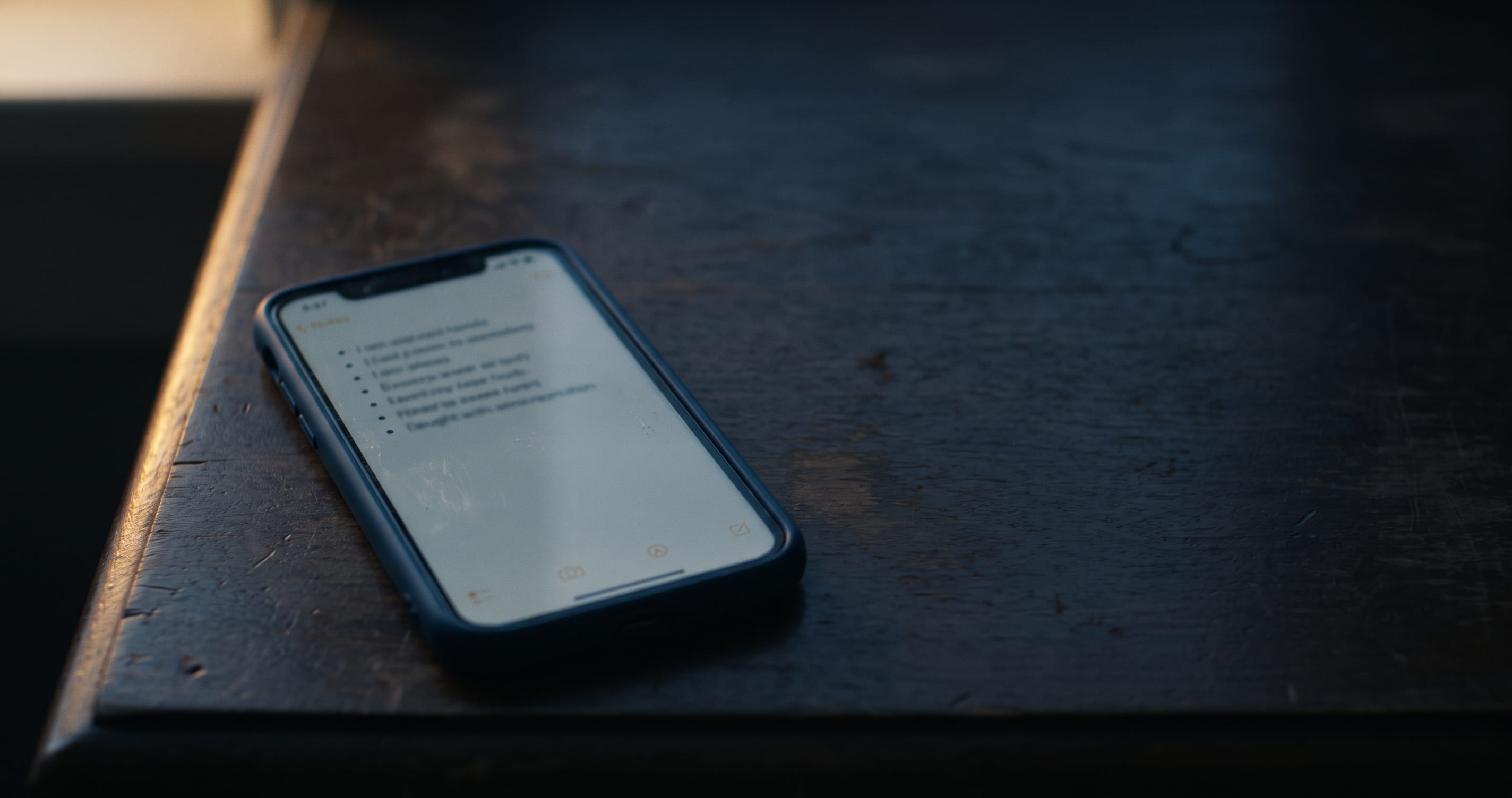
I start and end every day by reading the same short list on my phone.
Eight lines. Nothing clever. It takes about forty seconds.
That list has carried me through some genuinely hard days, and it is the single easiest thing I do to stay present and make decent decisions.
TL;DR
A mental state checklist is a short list of reminders about how you want to operate, kept somewhere you will see it, read first thing and last thing. Not goals, not affirmations. Instructions. Mine has eight lines covering how I want to show up, how I want to treat people, and what I refuse to chase. I read it in the morning to set the day, at night to sleep on the right thoughts, and in the middle of a bad afternoon when emotions are running the show. Spend thirty minutes writing yours. Keep it short enough to recite from memory, or you will stop reading it by week two.
In this article
- What a mental state checklist actually is
- Why a list works when willpower does not
- When I read mine
- What is actually on mine
- Why this is not affirmations or a personal creed
- How to write yours in 30 minutes
- Four rules that keep it working
- What it does on a genuinely bad day
- Common questions about a mental state checklist
What a Mental State Checklist Actually Is
It is a short written list of how you want to operate, kept where you will actually see it.
Mine lives in my phone notes, pinned to the top so it is the first thing there when I open the app.
It is not a to-do list. Nothing on it gets ticked off. It is not goals either, because there is nothing to achieve.
It is closer to a set of instructions for being me on a normal day. Read it, and you are reminded how you decided to behave back when you were calm and thinking clearly.
That last part is the whole trick. You write it on a good day so it is there for you on a bad one.
Why a List Works When Willpower Does Not
Emotions arrive faster than decisions.
Something happens, you feel it, and you have reacted before any thinking got involved. Then you spend the rest of the afternoon defending a reaction you never really chose.
You cannot out-willpower that in the moment. The moment is already gone.
What you can do is decide in advance. When you read the same eight lines every morning, you are loading them in before the day starts throwing things at you.
Then something happens at two in the afternoon, and instead of nothing being available, one of the lines turns up. Be curious. Be calm. That is often all it takes to leave a gap between the feeling and the response.
You are not controlling the emotion. You are controlling what you do with it, which is the only bit that was ever yours.
When I Read Mine
Three times, and each one does a different job.
First thing in the morning. This sets the state I want to operate from before anyone needs anything from me. It sits alongside the rest of my morning practice, which I have written out in the morning routine that changed my life.
Last thing at night. This one surprised me. Reading it before sleep means the last thoughts in my head are ones I chose, rather than whatever the day left lying around.
Anyone who has lain awake replaying a conversation knows what the alternative looks like.
In the middle of a bad day. When I am stressed, or there is a lot of emotion moving, I open it and read it again. Forty seconds, and I am usually back in the room.
That third use is the one people skip, and it is the most powerful of the three.
What Is Actually on Mine
Here is my list, as it is written. Yours should look nothing like it, and I will explain why in a minute.
Be calm, relaxed and non-judgemental. The whole list starts here because everything else gets easier from that state. Non-judgemental matters most. Most of my worst decisions came from deciding something or someone was a certain way before I actually knew.
Money is everywhere and I do not need to chase it. This one keeps me from making decisions out of scarcity. Chasing makes you push, and pushing makes people feel pushed. It is a reminder about how to behave, not a claim about my bank balance.
Be curious, ask questions. The fastest way out of my own head is to get interested in someone else's. It also happens to be the thing that makes conversations go well.
Help people and give what I can. Not everything, what I can. A day where I have been useful to somebody lands differently from one where I have not.
Be accountable in my own life. If something is not working, it is mine to fix. Blame is comfortable and it changes nothing.
Be truthful in all areas of my life and to myself. The second half of that is the hard half. It is easy to be honest with other people and still tell yourself a story about why you did not do the thing.
Be kind. Two words, and the shortest line on the list. It is there because on the days I am stressed it is the first thing to go, and it is the one that costs other people the most when it does.
You do not own negative thoughts. It is a choice to believe them. This one is a reminder rather than an instruction, which breaks my own rule slightly. It earns its place because it is the line I need at two in the afternoon when a thought has already been running for an hour and I have been treating it as a fact.
Eight lines. I can recite them without looking, which is exactly the point.
It was six for a long time. The last two went on more recently, which is how this is supposed to work. You review it every few months and change it slowly.
Want more of this in your inbox?
Free weekly tips on confidence, self-belief and daily practice. No sales pitch, ever.
Get the Free Email SeriesWhy This Is Not Affirmations or a Personal Creed
The idea of reading a written statement morning and night is not new. It goes back at least to Napoleon Hill in Think and Grow Rich, and people usually call the result a personal creed or a personal manifesto.
What I do is a bit different, and the difference is what makes it stick.
A personal manifesto is usually a values statement. Who I am, what I stand for. They tend to be long, beautifully written, and read twice before quietly dying in a notes app.
An affirmation is a claim about yourself. I am confident. I am successful. If part of you does not believe it, saying it just starts an argument in your own head.
A checklist is neither. It is an instruction.
Be curious is not a claim I have to believe about myself. It is something I can simply do in the next conversation, whatever mood I am in.
That is why it survives a bad week. You cannot fail an instruction, you can only follow it or not, and either way it is there again tomorrow.
If affirmations are what you are actually after, I would pair them with the guarding work in why you are already enough, because on their own they rarely hold.
Where the Checklist Fits Into Changing Your State
Tony Robbins breaks your emotional state into three parts: your physiology, your language and your focus. A written checklist is a direct lever on the last two, which is why reading it can shift how you feel in under a minute.
How to Write Yours in 30 Minutes
Give it half an hour and do it properly once. You will edit it later, but the first pass deserves real attention.
1. Start With Your Bad Days, Not Your Good Ones
Think about the last few times you did not like how you behaved. Snapped at someone. Went quiet. Made a rushed decision.
What would you have needed to remember in that moment? That is your first line.
Most people write their list from their ambitions. Write it from your patterns instead and it will actually be useful.
2. Write Instructions, Not Descriptions
Be curious. Be accountable. Give what you can.
Each line should be something you could act on within the next ten minutes. If you cannot picture doing it, rewrite it.
3. Name What You Refuse to Chase
One or two lines about what you are not doing is worth as much as the positive ones.
Mine is money. Yours might be approval, being right, or being busy. Whatever quietly pulls you off course belongs on the list.
4. Check It Against Your Why
Every line should point back at the reason you do what you do. If a line does not connect to that, it is decoration.
If you have not worked that out yet, do it first. I have written the exercise I use in how to find your why.
5. Cut It Down
Aim for five to eight lines. Then cut one more.
If you cannot recite it from memory after two weeks, it is too long, and a list you do not read is not a tool.
Four Rules That Keep It Working
Keep it somewhere frictionless. Mine is pinned in my phone notes. If it takes more than two taps, you will stop opening it.
Read it out of habit, not need. The days you do not feel like you need it are the days that build the habit. Skipping those is how people lose it.
Change it slowly. Review it every few months, not every week. Constant editing turns it into a project rather than a practice.
Make it yours, properly. Do not copy mine. A borrowed list reads like advice, and advice is easy to ignore. Your own words carry weight that someone else's never will.
None of these are hard. They are just the four things that decide whether you still have this in six months, and keeping a promise like that to yourself is its own quiet win, which I write about in how to keep a promise to yourself.
What It Does on a Genuinely Bad Day
I want to be straight about this. A checklist does not make you win every day.
Some days go badly and no list changes that. Anyone promising otherwise is selling something.
What it does is stop a bad day turning into a bad week.
Without it, a hard morning used to set the tone for everything after it. I would carry it into the afternoon, make worse decisions from it, and go to bed with all of it still running.
Now there is a point where I stop, read eight lines, and remember how I decided to operate. The day is still hard. I am just not adding to it.
Over months, that is the whole difference. Not never having bad days, but not compounding them.
It works even better next to a daily sit-down practice. The checklist tells you how to operate, and meditation is what makes you able to notice you have stopped. I have written the method I use in how to meditate when you cannot concentrate, and the emotional release side of it in how I let go of negative thoughts and feelings every day.
If you want a way of naming which state you are actually in before you reach for the list, the Map of Consciousness explained simply is the framework I use for that.
Written yours? Tell me how you got on.
Building a checklist around what you actually need is what I work through in self-belief coaching. No sales script, just a real reply from me.
Contact MeCommon Questions About a Mental State Checklist
How is this different from affirmations?
An affirmation is a claim about who you are, which part of you may not believe yet. A checklist line is an instruction you can act on immediately, whatever mood you are in. You cannot fail an instruction, you can only follow it or not, so it survives the days when you do not feel like yourself.
How many things should be on the list?
Five to eight lines. Mine has eight. The real test is whether you can recite it from memory after a couple of weeks, because a list you have to concentrate to get through is one you will stop opening.
Where should I keep it?
Somewhere that takes two taps or less. I pin mine to the top of my phone notes. A lock screen, a card in your wallet or a note by the kettle all work too. Friction is the only thing that kills this habit.
Can I just use someone else's list?
You can borrow the structure, but not the lines. Someone else's list reads like advice, and advice is easy to ignore at the exact moment you need it. Write yours from your own patterns and it will carry weight a copied one never does.
How long before it makes a difference?
The night-time reading changes how you fall asleep almost immediately. The rest builds over a few weeks, as the lines start turning up on their own in the middle of a difficult moment. That is the point where it starts doing real work.
What if I read it and still lose control of how I feel?
That will happen, and it does not mean the list is not working. This is a tool for steadying yourself day to day, not a way of never feeling anything difficult. If emotions regularly feel unmanageable or are affecting your daily life, speak to your GP or a qualified therapist.
Written by Harry
Not a trained life coach or counsellor, just sharing what has helped me on my own journey. For more free guides on confidence, self-belief and letting go, visit the blog. To read the full story, see the about page.